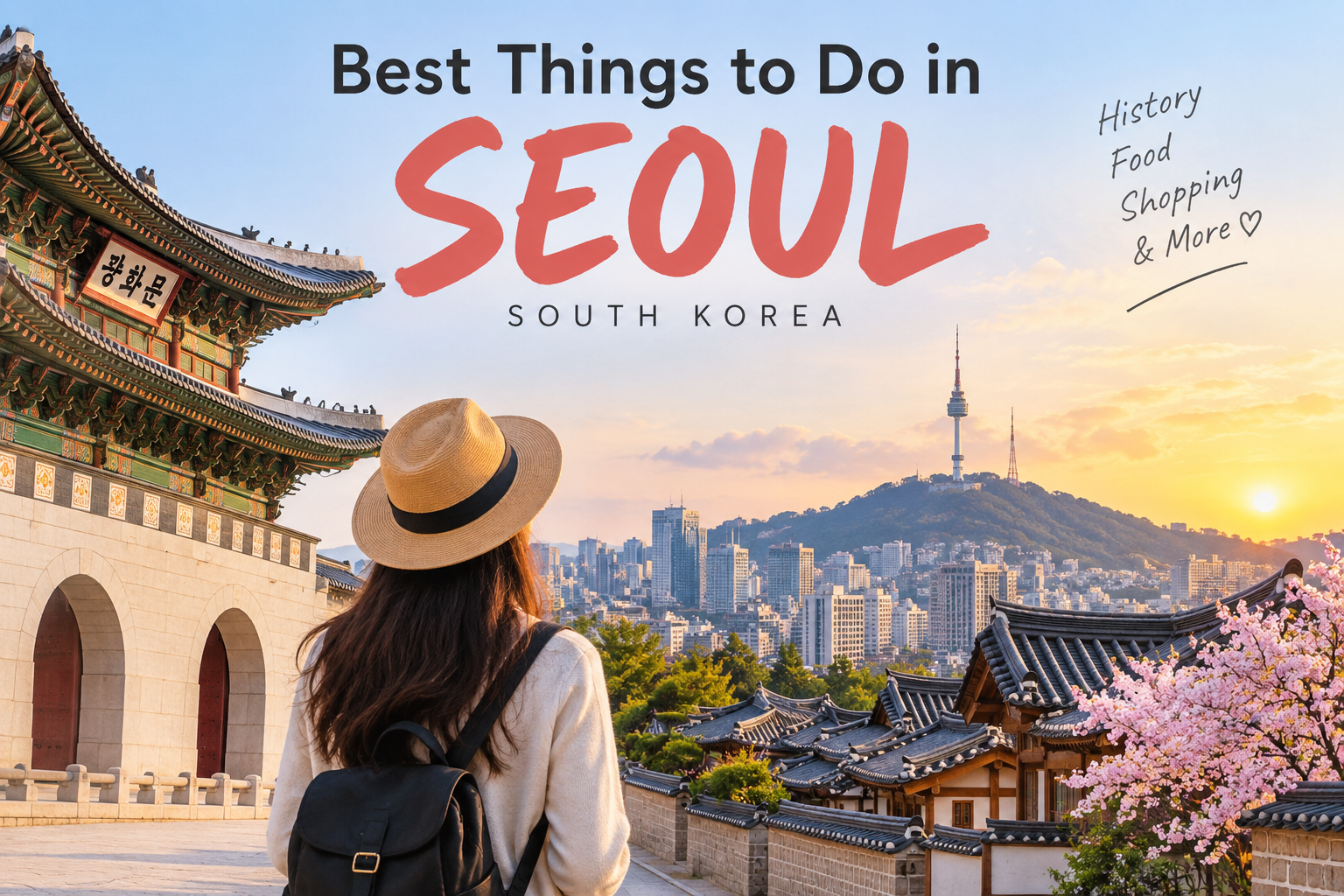
Seoul is one of those cities where centuries-old palaces, neon-lit shopping streets, quiet hanok neighborhoods, trendy cafés, mountains, and modern skyscrapers all exist within a short subway ride of one another.
For first-time visitors, that can also make Seoul a little overwhelming.
Should you spend your time exploring royal palaces? Shopping in Myeongdong? Eating your way through traditional markets? Visiting K-pop spots in Gangnam? Or simply sitting beside the Han River with fried chicken?
The answer is: a little of all of them.
If this is your first trip to South Korea, here are the best things to do in Seoul to experience the city’s history, food, neighborhoods, shopping, nightlife, and modern Korean culture.
1. Visit Gyeongbokgung Palace
If you visit only one royal palace in Seoul, make it Gyeongbokgung Palace.
Built in 1395, Gyeongbokgung was the first and largest royal palace of Korea’s Joseon Dynasty and remains one of Seoul’s most important historic landmarks. Visit Seoul
The huge palace complex includes traditional gates, courtyards, royal halls, gardens, and mountain views.
One of the most popular experiences for international visitors is renting a hanbok, traditional Korean clothing, from one of the many rental stores near the palace.
Visitors wearing a complete hanbok can enter Gyeongbokgung Palace for free under the current palace admission policy. Visit Seoul
First-time visitor tip
Try to arrive in the morning before the biggest crowds.
Allow around 1.5 to 2 hours for the palace.
You can easily combine Gyeongbokgung with:
Gwanghwamun Square → Gyeongbokgung → Bukchon Hanok Village → Insadong
for one excellent half-day itinerary.
2. Walk Through Bukchon Hanok Village
Just a short walk from Gyeongbokgung is Bukchon Hanok Village, one of the best places to see traditional Korean architecture.
Bukchon sits between Gyeongbokgung and Changdeokgung palaces and contains streets lined with traditional Korean houses known as hanok. Unlike a theme park built for tourists, Bukchon is still a real residential neighborhood. Visit Seoul
That distinction is important.
People actually live here, so visitors should keep noise levels down and respect residential restrictions.
You’ll find:
- Traditional hanok houses
- Small galleries
- Craft workshops
- Tea houses
- Cafés
- Beautiful views of traditional rooftops against modern Seoul
It is one of the best places in the city to understand how dramatically Seoul has changed over the centuries.
3. Explore Insadong
After Bukchon, walk toward Insadong.
This is one of the easiest neighborhoods for first-time visitors to experience traditional Korean culture without traveling far from central Seoul.
Look for:
- Traditional crafts
- Korean ceramics
- Calligraphy
- Souvenir shops
- Tea houses
- Traditional sweets
- Art galleries
If you’re buying gifts to bring back to the United States, Insadong is generally more interesting than buying generic souvenirs at the airport.
Nearby Ikseon-dong is also worth visiting.
Its narrow alleys contain renovated hanok buildings filled with cafés, restaurants, boutiques, and dessert shops.
4. Eat Your Way Through Gwangjang Market
One of the best introductions to Korean food is Gwangjang Market.
It’s one of Seoul’s best-known traditional markets and is especially famous among visitors for foods such as bindaetteok, a crispy mung-bean pancake, and Korean-style rolls. Seoul’s official tourism guide also includes Gwangjang Market among its recommended stops for first-time visitors. Visit Seoul
Foods worth trying include:
Bindaetteok – mung bean pancake
Mayak gimbap – small seaweed rice rolls
Mandu – Korean dumplings
Tteokbokki – spicy rice cakes
Yukhoe – seasoned raw beef
Kalguksu – knife-cut noodles
Don’t feel pressured to try everything.
Pick two or three foods and share them if you’re traveling with someone.
That leaves room for the rest of Seoul.
5. Experience Myeongdong
For a completely different side of Seoul, head to Myeongdong.
This is one of the city’s most famous shopping districts and an easy introduction to modern Korean retail culture.
You’ll find:
- Korean cosmetics
- Skincare
- Fashion
- Department stores
- Duty-free shops
- Restaurants
- Street snacks
Seoul’s tourism authority describes Myeongdong as one of central Seoul’s major shopping districts, combining department stores, duty-free shopping, international brands and street food. Visit Seoul
For American visitors interested in K-beauty, this is one of the easiest places to compare products in one area.
Popular Korean skincare stores are everywhere.
Best time to visit
Myeongdong is most fun from the late afternoon into the evening, when shops and food stalls are busiest.
6. See Seoul From N Seoul Tower
For a classic panoramic view of Seoul, visit N Seoul Tower on Namsan Mountain.
The tower is one of Seoul’s signature landmarks and provides a wide view across the city. Official Seoul tourism itineraries consistently include Namsan and N Seoul Tower among recommended first-time attractions. Visit Seoul
The best time to visit is around sunset.
You’ll see Seoul change from a huge daytime metropolis into a sea of lights.
You can reach the area by:
- Namsan Cable Car
- Bus
- Walking trails
If you enjoy walking, taking the cable car or bus up and walking part of the way down can be a nice compromise.
7. Spend an Evening by the Han River
This is one experience that doesn’t always make it onto traditional sightseeing lists, but it should.
The Han River is part of everyday life in Seoul.
Locals come to riverside parks to:
- Walk
- Cycle
- Picnic
- Jog
- Meet friends
- Watch the sunset
- Eat convenience-store ramen
- Order fried chicken
For many international visitors, this ends up being one of their favorite memories of Seoul because it feels less like sightseeing and more like actually spending time in the city.
Popular riverside areas include:
Yeouido Hangang Park
Banpo Hangang Park
Ttukseom Hangang Park
Try going just before sunset.
Buy some food, find a spot along the river, and stay until the city lights come on.
8. Explore Hongdae at Night
If you want to experience Seoul’s youthful side, head to Hongdae.
The area around Hongik University is known for:
- Restaurants
- Bars
- Cafés
- Fashion
- Street performances
- Karaoke
- Clubs
- Photo booths
- Korean pop culture
It is especially lively in the evening.
You don’t need to be interested in nightlife to enjoy Hongdae. There are plenty of shops, cafés, restaurants, and entertainment venues that stay active well into the night.
For younger travelers visiting Korea for the first time, Hongdae is one of the easiest neighborhoods to enjoy without a complicated itinerary.
9. Discover Seongsu, Seoul’s Trendiest Neighborhood
If you want to see the Seoul that young Koreans are currently enjoying, spend a few hours in Seongsu-dong.
Former factories and warehouses have been transformed into:
- Design stores
- Fashion boutiques
- Pop-up shops
- Restaurants
- Bakeries
- Specialty coffee shops
- K-beauty stores
It has a very different atmosphere from traditional tourist districts such as Myeongdong.
That’s precisely why it’s worth visiting.
Combine Seongsu with Seoul Forest for an easy half-day trip.
For travelers interested in Korean fashion, cafés, skincare, design, or social-media trends, Seongsu should be near the top of the list.
10. Visit Gangnam and COEX
Yes, this is the Gangnam from “Gangnam Style.”
But modern Gangnam is much more than a pop-culture reference.
It’s one of Seoul’s major commercial and entertainment districts.
A first-time itinerary could include:
Gangnam Station → COEX → Starfield Library → Bongeunsa Temple
COEX is particularly useful during very hot, cold, or rainy weather because much of the area is indoors.
The contrast between futuristic shopping complexes and nearby Buddhist temples also captures something essential about Seoul: old and new rarely exist separately.
They’re often right next to each other.
11. Try Korean BBQ
You haven’t really completed a first trip to Seoul without sitting around a grill and eating Korean barbecue.
Popular options include:
Samgyeopsal – pork belly
Galbi – marinated ribs
Bulgogi – marinated beef
Hanwoo – premium Korean beef
Meals usually come with several small side dishes called banchan.
A useful tip for American visitors:
Korean barbecue is normally a social meal. Many restaurants prefer or require orders for at least two servings of meat.
If you’re traveling alone, search specifically for restaurants that accommodate solo diners.
12. Visit a Korean Convenience Store
It may sound strange to list a convenience store as a tourist activity.
Do it anyway.
Stores such as CU, GS25 and 7-Eleven are deeply integrated into daily life in Korea.
Try:
- Instant ramen
- Triangle gimbap
- Korean snacks
- Ice cream
- Ready-made meals
- Coffee
- Korean drinks
Some convenience stores have tables where you can prepare and eat ramen immediately.
It’s inexpensive, easy and surprisingly fun for first-time visitors.
13. Visit a Traditional Market
Gwangjang is famous, but it isn’t the only market worth exploring.
Consider:
Namdaemun Market – shopping and traditional food
Mangwon Market – neighborhood atmosphere and snacks
Tongin Market – smaller traditional market near Gyeongbokgung
Markets are particularly useful for visitors who want to experience ordinary Korean food beyond restaurant districts.
14. Take a Walk Along Cheonggyecheon Stream
Running through central Seoul, Cheonggyecheon provides a surprisingly peaceful walking route surrounded by dense city streets and office buildings.
It works particularly well as an evening walk after sightseeing around:
Gwanghwamun → Jongno → Dongdaemun
It’s also free.
When your itinerary starts feeling overloaded—and Seoul itineraries have a habit of doing that—this is a good place to slow down.
15. Experience Korean Café Culture
Seoul takes cafés very seriously.
You’ll find:
- Minimalist design cafés
- Hanok cafés
- Rooftop cafés
- Bakery cafés
- Theme cafés
- Specialty coffee shops
- Dessert cafés
Some people initially think cafés are just places to grab coffee between attractions.
In Seoul, cafés can be the attraction.
Neighborhoods particularly good for café hopping include:
Seongsu
Ikseon-dong
Yeonnam-dong
Hannam-dong
Hongdae
Build some unstructured café time into your itinerary instead of trying to visit another five landmarks.
You’ll probably enjoy the city more.
Best Seoul Experiences for Different Travelers
If you’re overwhelmed by the options, choose based on your interests.
| If you like… | Go here |
|---|---|
| Korean history | Gyeongbokgung, Bukchon, Insadong |
| Korean food | Gwangjang Market, Mangwon Market |
| Shopping | Myeongdong, Seongsu, Gangnam |
| K-beauty | Myeongdong, Seongsu |
| Nightlife | Hongdae, Itaewon |
| City views | N Seoul Tower |
| Local atmosphere | Han River |
| Cafés | Seongsu, Ikseon-dong |
| Korean fashion | Seongsu, Hongdae |
| Modern Seoul | Gangnam, COEX |
A Perfect First Day in Seoul
If you only have one full day, don’t try to cross the entire city.
Use this route:
Morning
Gyeongbokgung Palace
↓
Bukchon Hanok Village
↓
Insadong
Lunch
Try Korean food around Jongno or Insadong.
Afternoon
Gwangjang Market
↓
Myeongdong
Evening
N Seoul Tower
This gives you Korean history, traditional architecture, food, shopping, and a panoramic city view in one reasonably efficient route.
Seoul’s official tourism guide similarly groups attractions such as Myeongdong, Bukchon, Gwangjang Market, Gwanghwamun, Namsan and Hongdae into recommended itineraries for first-time visitors. Visit Seoul
How Many Days Do You Need in Seoul?
For most first-time visitors:
3 days: enough for the highlights
4–5 days: ideal for most travelers
7 days: enough to explore neighborhoods at a relaxed pace and take day trips
If Korea is your first trip to East Asia, I’d recommend at least four full days in Seoul.
The city is much larger than it initially appears on a map.
Trying to fit Gyeongbokgung, Hongdae, Gangnam, Seongsu, Myeongdong, the Han River and a DMZ trip into two days will mostly result in you becoming extremely familiar with Seoul’s subway system.
Getting Around Seoul
The Seoul subway is generally the easiest way for international visitors to get around.
For navigation, many travelers discover that Google Maps is less useful for detailed Korean transit and walking navigation than they expect.
Install:
Naver Map or KakaoMap
before your trip.
A rechargeable transportation card such as T-money is also useful for buses and subways.
When Is the Best Time to Visit Seoul?
The most comfortable periods are generally:
Spring
April–May
Mild temperatures and spring flowers make this one of the most popular seasons.
Fall
October–November
Cooler temperatures and autumn foliage make walking around Seoul particularly enjoyable.
Summer
June through August can be hot, humid, and rainy.
Winter
December through February can be very cold, but accommodation can sometimes be more affordable and crowds smaller.
Frequently Asked Questions
Is Seoul easy for Americans to visit?
Yes. Seoul has extensive public transportation, major tourist attractions have English signage, and many tourist-oriented businesses can handle at least basic English.
However, downloading a translation app and Korean navigation app makes the trip considerably easier.
Is Seoul safe for tourists?
Seoul is generally considered a comfortable city for international tourists, including people traveling alone.
Normal travel precautions still apply, particularly around nightlife districts and personal belongings.
Can I visit Seoul without speaking Korean?
Yes.
You do not need to speak Korean to visit Seoul.
Learning a few simple phrases such as annyeonghaseyo (hello) and gamsahamnida (thank you) is appreciated, but navigation and basic travel are manageable with translation apps.
What is the number one thing to do in Seoul?
For most first-time visitors, Gyeongbokgung Palace is the best place to start.
It introduces Korea’s royal history and can easily be combined with Bukchon, Insadong, Gwanghwamun and nearby traditional neighborhoods.
What should I not miss in Seoul?
If your time is limited, prioritize:
Gyeongbokgung Palace, Bukchon Hanok Village, Korean food, Myeongdong or Seongsu, the Han River, Hongdae, and N Seoul Tower.
Together they provide a good balance of traditional and modern Seoul.
Final Thoughts
The biggest mistake first-time visitors make in Seoul is trying to see too much.
Seoul isn’t just a checklist of tourist attractions.
Spend a morning exploring Korea’s royal history, eat lunch in a traditional market, browse Korean skincare or fashion in the afternoon, then finish the day beside the Han River or looking over the city from Namsan.
That’s when Seoul starts making sense.
For a first trip, four to five days is an excellent amount of time to see the highlights while still leaving enough room to discover places you didn’t plan to visit.
And in Seoul, those unplanned places often end up being the best part of the trip.