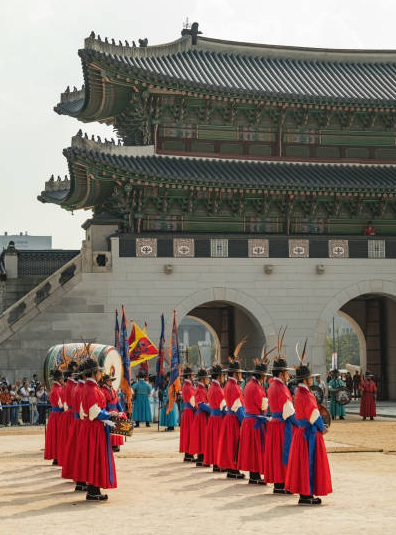
gyeongbokgung palace changing of the guard
If you want to experience Korean royal history without spending money on a guided tour, the Gyeongbokgung Palace Changing of the Guard is one of the most memorable cultural performances in Seoul.
Dressed in colorful Joseon Dynasty military uniforms, royal guards march beneath historic palace gates while traditional drums and ceremonial instruments accompany the procession.
The performance recreates the changing of the guards who protected the royal palace during Korea’s Joseon Dynasty.
The regular ceremony takes place at 10:00 AM and 2:00 PM, lasts approximately 20 minutes, and is free to watch. It normally operates Wednesday through Monday, excluding palace closure days and schedule changes.
However, special events sometimes replace the regular ceremony.
2026 Schedule Alert: From October 29 through November 1, the regular changing ceremony is replaced by special programming associated with the Cheopjong Royal Guard Inspection. On November 1, the Gwanghwamun guard duty performance is scheduled at 10:00 AM and 1:00 PM, while Cheopjong takes place at 11:00 AM and 2:00 PM.
This guide explains the regular schedule, the meaning of the ceremony, where to watch, transportation, admission fees, photography tips and what to do afterward.
1. Gyeongbokgung Palace Changing of the Guard: Quick Facts
| Information | Details |
|---|---|
| Official Event | Changing of the Royal Palace Guard Ceremony |
| Korean Name | 수문장 교대의식 |
| Location | Heungnyemun Gate area, Gyeongbokgung Palace |
| Address | 161 Sajik-ro, Jongno-gu, Seoul |
| Regular Times | 10:00 AM and 2:00 PM |
| Duration | Approximately 20 minutes |
| Ceremony Admission | Free |
| Reservation | Not required |
| Regular Days | Wednesday–Monday |
| Closed | Tuesdays and designated closure days |
| Weather | Subject to cancellation or change |
| Nearest Subway | Gyeongbokgung Station, Line 3 |
The ceremony is separate from visiting the ticketed inner palace grounds.
You can watch the public guard-changing performance without purchasing a regular palace admission ticket.
2. What Is the Changing of the Royal Palace Guard?
The guard-changing ceremony recreates a military practice from the Joseon Dynasty, which ruled Korea from 1392 to 1897.
During this period, palace guards were responsible for protecting important gates, controlling access and maintaining royal security.
The officer commanding the palace gate guards was called the Sumunjang.
The ceremony recreates the formal handover of responsibility between the departing guard unit and the incoming unit.
Why Were Palace Guards Important?
Gyeongbokgung was the principal royal palace of the Joseon Dynasty.
Its gates provided important access points to the royal compound.
Guarding these gates required an organized military structure with officers, soldiers, weapons and prescribed duties.
The ceremony helps modern visitors understand an aspect of palace life that is often overlooked when exploring historic buildings.
Is the Ceremony Historically Authentic?
The modern event is a historical reenactment rather than an uninterrupted ceremony preserved from the Joseon period.
Its uniforms, military formations and ceremonial objects have been reconstructed using historical records.
The performance is designed to introduce visitors to royal guard culture in an accessible and visually engaging way.
3. Gyeongbokgung Guard Changing Ceremony Schedule
Several different guard-related performances take place around Gyeongbokgung.
They should not be confused with one another.
Regular Daily Schedule
| Performance | Time | Duration |
|---|---|---|
| Royal Guard Public Training | 9:35 AM | 15 minutes |
| Royal Guard Changing Ceremony | 10:00 AM | 20 minutes |
| Gwanghwamun Guard Duty Performance | 11:00 AM | 10 minutes |
| Gwanghwamun Guard Duty Performance | 1:00 PM | 10 minutes |
| Royal Guard Public Training | 1:35 PM | 15 minutes |
| Royal Guard Changing Ceremony | 2:00 PM | 20 minutes |
These are the officially published regular times.
Events normally operate Wednesday through Monday.
Performances may be altered or canceled because of adverse weather, extreme heat, official ceremonies or operational conditions.
Is There a Ceremony on Tuesday?
Normally, no.
Gyeongbokgung Palace is generally closed on Tuesdays.
The guard-changing performances are not normally held on palace closure days.
Holiday arrangements can affect the closure schedule, so check the official calendar when planning around a Korean public holiday.
4. Special 2026 Event: Cheopjong Royal Guard Inspection
From October 30 through November 1, 2026, Gyeongbokgung is presenting a special reenactment of Cheopjong.
Cheopjong was a military inspection ritual in which a Joseon king summoned and inspected his palace guards.
The modern reenactment includes military formations, demonstrations and ceremonial elements based on historical sources.
November 1 Special Schedule
| Event | Time | Location |
|---|---|---|
| Gwanghwamun Guard Duty Performance | 10:00 AM | Gwanghwamun area |
| Cheopjong Royal Guard Inspection | 11:00 AM | Heungnyemun Plaza |
| Gwanghwamun Guard Duty Performance | 1:00 PM | Gwanghwamun area |
| Cheopjong Royal Guard Inspection | 2:00 PM | Heungnyemun Plaza |
| Special Guard Patrol | 3:30 PM | Subject to announced route and conditions |
The standard guard-changing ceremony is not scheduled during this special event period.
Visitors should avoid planning around the normal 10 AM and 2 PM changing ceremony without checking the special-event notice.
The Cheopjong program offers a different opportunity to see Joseon-era royal military culture.
After November 1, check the latest regular performance notices rather than assuming the special schedule continues.
5. Where Does the Ceremony Take Place?
The main royal guard-changing ceremony is held around Heungnyemun Gate, just inside the Gwanghwamun entrance area of Gyeongbokgung Palace.
Gwanghwamun is the palace’s principal southern gate.
Heungnyemun stands farther inside, leading toward the main palace complex.
Where Is the Best Place to Watch?
For an unobstructed view, choose an approved spectator area around Heungnyemun Plaza.
From there, visitors can observe the ceremonial formations, traditional costumes, flags and musicians.
The exact spectator boundaries can change depending on the performance and crowd-management arrangements.
How Early Should You Arrive?
Arriving approximately 15–20 minutes before the published start time is a practical recommendation.
It provides extra time to find the correct viewing area and prepare a camera.
This is not an official mandatory arrival time.
During particularly busy weekends or special events, allow more flexibility.
6. What Happens During the Changing of the Guard?
The performance consists of several ceremonial stages.
Arrival of the Guard Units
The incoming and outgoing guard groups take their positions according to the ceremonial arrangement.
The participants wear colorful traditional military uniforms inspired by historical records.
Military Commands and Inspections
Officers perform formal exchanges and inspections as part of the handover.
The procedure symbolizes the transfer of responsibility for protecting the palace gate.
Traditional Music
A ceremonial military band accompanies the procession.
Traditional instruments create rhythmic signals and enhance the atmosphere.
Completion of the Handover
After the formal exchange, the new guards take up their duties.
The complete reenactment takes approximately 20 minutes during regular operations.
7. Royal Guard Changing vs Guard Duty Performance
Visitors sometimes assume that every palace guard activity is the same ceremony.
In fact, the programs have different purposes and lengths.
| Feature | Changing Ceremony | Guard Duty Performance |
|---|---|---|
| Main Purpose | Formal transfer of guard command | Inspection and routine guard duties |
| Regular Times | 10 AM, 2 PM | 11 AM, 1 PM |
| Duration | About 20 minutes | About 10 minutes |
| Main Area | Heungnyemun Plaza | Gwanghwamun Gate |
| Admission | Free | Free |
| Reservations | Not required | Not required |
Which One Should You Watch?
For first-time visitors, the full guard-changing ceremony is generally the more comprehensive experience.
It involves larger formations and a more elaborate reenactment.
However, the shorter guard duty performance is also useful if your sightseeing schedule is limited.
During special events, the available programs may differ.
8. Is Gyeongbokgung Changing of the Guard Free?
Yes.
The official organizer lists the guard-changing ceremony as a free public performance.
No advance reservation is required to watch it.
What About Gyeongbokgung Palace Admission?
Admission to the palace’s regular ticketed areas is a separate matter.
The standard adult admission price is ₩3,000 for visitors in the applicable age category.
Certain age groups and other eligible visitors can enter for free.
Visitors wearing hanbok that meets the official dress guidelines may also qualify for free entry.
Is Hanbok Required?
No.
You do not need to wear hanbok to watch the guard-changing ceremony.
Ordinary comfortable travel clothing is fine.
Renting hanbok is an optional cultural experience and photography activity, not a requirement for watching the performance.
9. How to Get to Gyeongbokgung Palace
Gyeongbokgung is located in central Seoul, near Gwanghwamun Square.
Address: 161 Sajik-ro, Jongno-gu, Seoul, South Korea
Option 1: Gyeongbokgung Station, Subway Line 3
Take Subway Line 3 to Gyeongbokgung Station.
Exit 5 is a convenient access point toward the palace.
Follow pedestrian signs to the Gwanghwamun and Heungnyemun areas.
Option 2: Gwanghwamun Station, Subway Line 5
Take Subway Line 5 to Gwanghwamun Station.
Exit 2 is a useful starting point for walking toward Gwanghwamun Square and the palace gate.
You can also enjoy views of the main palace entrance while approaching from the south.
Which Station Should You Choose?
If you are already traveling on Line 3, Gyeongbokgung Station is generally convenient.
If you want to explore Gwanghwamun Square before the ceremony, approaching from Gwanghwamun Station can be particularly attractive.
Use pedestrian navigation to confirm your exact route.
10. Best Photography Tips for the Royal Guard Ceremony
The ceremony is visually striking because of its traditional costumes, colorful flags and historic architectural setting.
It is an excellent subject for visitors interested in travel photography.
Photograph the Entire Formation
A wide composition can capture the palace gate, guards and ceremonial flags together.
This helps communicate the setting rather than focusing only on one participant.
Capture Uniform Details
Traditional hats, colorful robes and ceremonial objects provide interesting close-up subjects.
Avoid entering restricted areas or moving in front of the performance to obtain a photograph.
Use a Fast Shutter Speed
For marching guards, a faster shutter speed can reduce motion blur.
Exact camera settings depend on lighting, focal length and the speed of movement.
Choose the Background Carefully
Including the roof of Heungnyemun or Gwanghwamun can make your photographs more recognizable.
Try to avoid distracting modern elements when framing a traditional scene.
Respect Other Visitors
Do not obstruct the movement of the guards or block other spectators for extended periods.
Follow staff instructions and remain behind any marked boundaries.
11. Suggested Half-Day Gyeongbokgung Itinerary
The guard-changing ceremony can be combined with several nearby attractions.
Morning Plan
| Suggested Time | Activity |
|---|---|
| 9:15 AM | Arrive near Gyeongbokgung |
| 9:35 AM | Watch the public guard training |
| 10:00 AM | Watch the regular changing ceremony |
| 10:30 AM | Explore the palace grounds |
| 12:00 PM | Lunch near Seochon or Gwanghwamun |
| Afternoon | Visit the National Palace Museum or nearby streets |
This itinerary assumes the regular guard-changing schedule is operating.
It should not be applied without modification on special-event days such as November 1, 2026.
What Else Can You Visit Nearby?
Gyeongbokgung Palace: Explore historic halls, courtyards and royal architecture.
National Palace Museum of Korea: Discover royal artifacts and the history of the Joseon court.
Gwanghwamun Square: Walk through one of Seoul’s best-known public spaces.
Seochon: Enjoy traditional streets, cafés and small shops west of the palace.
Bukchon Hanok Village: Explore another historic neighborhood, subject to local visitor access and residential-area rules.
12. Best Time of Year to Watch the Ceremony
The program is held throughout the year, subject to the published schedule and operational conditions.
| Season | Advantages | Considerations |
|---|---|---|
| Spring | Comfortable temperatures | Popular sightseeing period |
| Summer | Bright daylight | Heat-related cancellations possible |
| Autumn | Pleasant weather and scenery | Busy weekends and special events |
| Winter | Clear atmosphere on some days | Cold and possible weather disruption |
What Happens If It Rains?
Performances may be canceled or adjusted because of rain, snow, extreme temperatures or other safety concerns.
The organizer’s current event announcement is the most useful source before visiting.
Is the Ceremony Held at Night?
The normal royal guard-changing ceremony is a daytime program.
Do not confuse it with separate palace night-opening programs, which have their own dates and admission rules.
13. Frequently Asked Questions
1. What time is the Gyeongbokgung Palace Changing of the Guard?
The regular ceremony is held at 10:00 AM and 2:00 PM, lasting approximately 20 minutes. Special-event schedules may replace these performances.
2. Is the Gyeongbokgung guard-changing ceremony free?
Yes. Watching the ceremony is free, and advance reservation is not required. Entering the ticketed palace grounds may involve a separate admission fee.
3. Is the ceremony held every day?
It normally operates Wednesday through Monday and does not run on Tuesdays or designated palace closure days. Weather and official events may also affect the schedule.
4. Where is the best place to watch the ceremony?
The Heungnyemun Gate area is the main viewing location. Arrive early enough to find an approved spectator position without obstructing the guards.
5. Can I take pictures with the royal guards?
Visitors can photograph the performances from public spectator areas. Some guard-related programs also provide designated photo opportunities, but visitors must follow staff instructions and not interfere with the reenactment.
14. Final Thoughts: Is the Royal Guard Changing Ceremony Worth Watching?
The Gyeongbokgung Palace Changing of the Guard is one of Seoul’s most accessible historical experiences.
It allows visitors to see traditional Joseon military uniforms, ceremonial formations, flags and music in an authentic palace setting.
The event is also free to watch, making it an excellent addition to a Seoul sightseeing itinerary.
For a first visit, plan around the regular 10 AM or 2 PM ceremony, arrive a little early and leave time afterward to explore the palace.
However, always check for temporary schedule changes.
On November 1, 2026, the regular ceremony is replaced by the special Cheopjong Royal Guard Inspection program.
Whether you are interested in Korean history, traditional clothing or travel photography, the palace guard performances offer a memorable introduction to Seoul’s royal heritage.
Last reviewed: November 1, 2026. The regular timetable is subject to weather conditions, special events and organizer announcements.