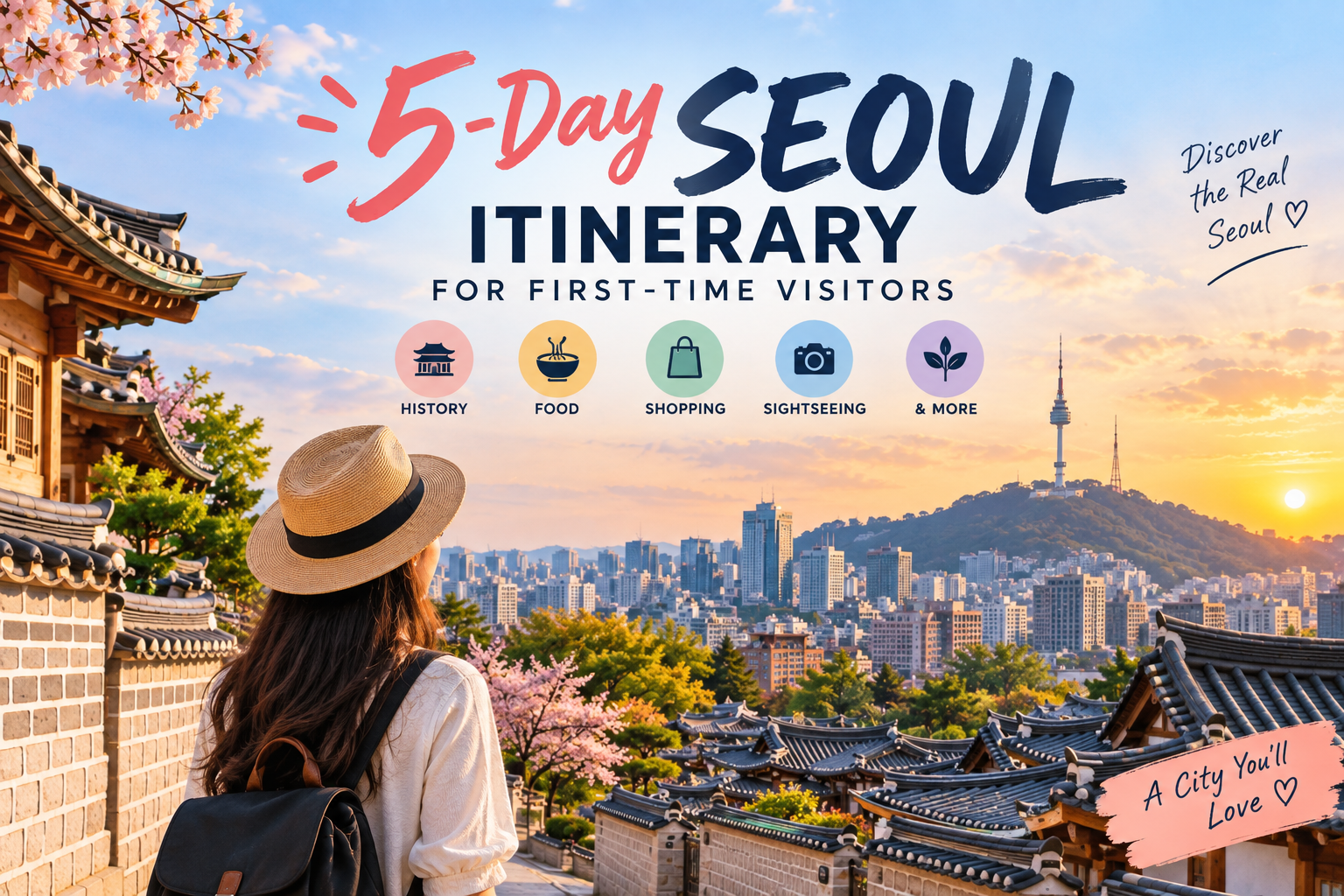
Five days is an excellent amount of time for a first trip to Seoul.
It gives you enough time to see the city’s essential historic landmarks while also experiencing modern Korean culture, shopping, food, cafés, nightlife, and the Han River.
The biggest mistake first-time visitors make is trying to cross Seoul several times in one day.
Seoul is enormous.
A better approach is to group attractions by neighborhood.
This 5-day Seoul itinerary does exactly that.
Seoul 5-Day Itinerary at a Glance
| Day | Area | Highlights |
|---|---|---|
| Day 1 | Central Seoul | Myeongdong, Namsan, N Seoul Tower |
| Day 2 | Historic Seoul | Gyeongbokgung, Bukchon, Insadong, Gwangjang |
| Day 3 | Western Seoul | Hongdae, Yeonnam, Mangwon, Han River |
| Day 4 | Eastern & Southern Seoul | Seongsu, Seoul Forest, COEX, Gangnam |
| Day 5 | Flexible Seoul | Itaewon, Hannam, shopping, museums |
This follows roughly the same geographic logic used in Seoul’s official tourism itineraries for first-time visitors. Visit Seoul
Day 1: Myeongdong, Namsan and N Seoul Tower
Your first day should be relatively easy.
After a long flight, don’t immediately attempt a 12-hour sightseeing marathon.
Use Day 1 to get comfortable with Seoul.
Morning or Early Afternoon: Check In and Explore Myeongdong
After arriving from Incheon International Airport, head to your hotel.
If you’re staying in:
- Myeongdong
- Seoul Station
- Hongdae
- Jongno
you’ll be well positioned for sightseeing.
Once you’ve checked in, explore Myeongdong.
Myeongdong is one of Seoul’s best-known shopping districts and is especially popular for:
- Korean skincare
- Cosmetics
- Fashion
- Department stores
- Street food
- Restaurants
For first-time American visitors, it is a very easy introduction to Seoul.
You don’t need much planning.
Just walk.
Late Afternoon: Walk Around Namsan
From Myeongdong, head toward Namsan Mountain.
If you’re tired, use the cable car or public transportation.
If you’re feeling energetic, walk part of the way.
Evening: N Seoul Tower
Finish your first day at N Seoul Tower.
The tower offers one of Seoul’s classic skyline views, and the official tourism guide especially recommends the night view.
Try to arrive before sunset.
You’ll see Seoul during daylight and then watch the city light up.
Day 1 Route
Hotel → Myeongdong → Namsan → N Seoul Tower
Day 1 Food Suggestions
Try:
- Korean fried chicken
- Samgyeopsal
- Tteokbokki
- Korean dumplings
- Convenience-store snacks
Keep the first day simple.
Jet lag is real.
Day 2: Gyeongbokgung, Bukchon, Insadong and Gwangjang Market
Day 2 is your traditional Seoul day.
This is probably the most important sightseeing day of the trip.
Morning: Gyeongbokgung Palace
Start early at Gyeongbokgung Palace.
Built in 1395, it was the first and largest of the main royal palaces of the Joseon Dynasty. Visit Seoul
Allow around 1.5 to 2 hours.
If you want the full experience, rent a hanbok near the palace.
Many visitors enjoy walking through the palace grounds in traditional Korean clothing.
Recommended Time
Around 9:00 AM–11:00 AM
Late Morning: Bukchon Hanok Village
From Gyeongbokgung, continue to Bukchon Hanok Village.
Bukchon sits between Gyeongbokgung and Changdeokgung and preserves streets lined with traditional Korean hanok houses. It is also a real residential neighborhood, so visitors should keep noise to a minimum. Visit Seoul
Spend around one hour here.
Don’t rush.
The small alleys are part of the experience.
Lunch: Insadong
Walk toward Insadong.
This is a good place to try traditional Korean food.
Possible lunch choices include:
- Bulgogi
- Bibimbap
- Korean set meals
- Mandu
- Traditional tea
After lunch, explore the shops.
Insadong is also one of the better areas for buying Korean-style souvenirs.
Afternoon: Ikseon-dong
Walk to nearby Ikseon-dong.
The area combines traditional hanok architecture with modern cafés, restaurants, boutiques, and dessert shops.
This is a good place to take a coffee break.
Evening: Gwangjang Market
Finish your day at Gwangjang Market.
Try several small dishes rather than one big meal.
Good choices include:
- Bindaetteok
- Gimbap
- Mandu
- Tteokbokki
- Kalguksu
Day 2 Route
Gyeongbokgung → Bukchon → Insadong → Ikseon-dong → Gwangjang Market
This grouping is very efficient because the attractions are relatively close together.
Day 3: Hongdae, Yeonnam-dong, Mangwon and the Han River
Day 3 is about modern, youthful Seoul.
Morning: Yeonnam-dong
Start in Yeonnam-dong.
This neighborhood near Hongdae is filled with:
- Cafés
- Bakeries
- Small restaurants
- Boutique stores
- Quiet side streets
Grab coffee and breakfast here.
Late Morning: Hongdae
Walk toward Hongdae.
The area surrounding Hongik University is famous for its young atmosphere.
Expect:
- Fashion
- Street performances
- Photo booths
- Cafés
- Karaoke
- Bars
- K-pop shops
Even during the day, Hongdae is worth exploring.
Lunch: Hongdae
This is a good day to try:
- Korean barbecue
- Dakgalbi
- Pork cutlet
- Korean fried chicken
- Jjajangmyeon
Afternoon: Mangwon Market
Take a short subway or taxi ride to Mangwon Market.
Mangwon feels more like a neighborhood market than a major tourist attraction.
That’s part of the appeal.
Try a few snacks and wander through the surrounding streets.
Late Afternoon: Han River
Continue toward the Han River.
You can walk around Mangwon Hangang Park or head toward another riverside park.
Pick up snacks or fried chicken.
Sit by the river and relax.
This is one of those experiences that feels much more local than another museum or landmark.
Evening: Return to Hongdae
Go back to Hongdae after dark.
The neighborhood changes dramatically at night.
You can enjoy:
- Street performances
- Bars
- Restaurants
- Karaoke
- Late-night shopping
Day 3 Route
Yeonnam-dong → Hongdae → Mangwon Market → Han River → Hongdae
Day 4: Seongsu, Seoul Forest, COEX and Gangnam
Day 4 is modern Seoul.
You’ll see why Seoul has become influential in fashion, beauty, cafés, design, and pop culture.
Morning: Seoul Forest
Start at Seoul Forest.
It’s a pleasant contrast to Seoul’s dense urban areas.
Walk through the park before Seongsu becomes busy.
Late Morning: Seongsu-dong
Then explore Seongsu.
Old industrial buildings here have been converted into:
- Cafés
- Fashion stores
- Pop-up shops
- Beauty stores
- Galleries
- Restaurants
For visitors interested in Korean trends, Seongsu is now one of Seoul’s most interesting neighborhoods.
Seoul’s official 4-night, 5-day beginner itinerary also places Seongsu and Seoul Forest together on the same day. Visit Seoul
Lunch: Seongsu
Have lunch here and visit a café afterward.
Don’t plan every café in advance.
Seongsu rewards wandering.
Afternoon: COEX and Starfield Library
Take the subway south to COEX.
Visit:
- COEX Mall
- Starfield Library
- Bongeunsa Temple
This combination is particularly interesting because a modern shopping and convention complex sits beside a historic Buddhist temple.
Evening: Gangnam
Continue to Gangnam Station.
Explore the surrounding streets and have dinner.
If you’d rather spend the evening outdoors, you can also head to Banpo Hangang Park.
Seoul’s official first-time itinerary similarly combines Gangnam, COEX and the Han River area. Visit Seoul
Day 4 Route
Seoul Forest → Seongsu → COEX → Gangnam → optional Han River
Day 5: Itaewon, Hannam-dong and Your Favorites
Don’t make Day 5 too rigid.
By this point, you’ll probably have discovered something you want to revisit.
Use the final day for a combination of culture, shopping and anything you missed.
Morning: War Memorial of Korea
For travelers interested in modern Korean history, visit the War Memorial of Korea.
It provides valuable context for understanding the Korean War and modern South Korea.
Allow about two hours.
Lunch: Itaewon
Head to nearby Itaewon.
Itaewon has long been one of Seoul’s most international neighborhoods.
It’s a good place if you want something other than Korean food after several days of eating locally.
Afternoon: Hannam-dong
Continue to Hannam-dong.
You’ll find:
- Korean fashion
- Galleries
- Cafés
- Boutiques
- Restaurants
It’s more relaxed than Myeongdong and often feels more upscale.
Final Evening: Choose Your Favorite Seoul Experience
For your final night, don’t automatically add another landmark.
Choose what you enjoyed most.
Options include:
Option 1 – Shopping
Return to:
- Myeongdong
- Seongsu
- Hongdae
Option 2 – Han River
Buy dinner and watch the sunset.
Option 3 – Night View
Return to Namsan or visit another skyline viewpoint.
Option 4 – Korean BBQ
Finish the trip with a proper Korean barbecue dinner.
Day 5 Route
War Memorial → Itaewon → Hannam-dong → flexible evening
Best Area to Stay for This 5-Day Seoul Itinerary
For first-time visitors, I would shortlist three areas.
Myeongdong
Best for:
- First-time visitors
- Shopping
- Central location
- Easy sightseeing
Hongdae
Best for:
- Younger travelers
- Nightlife
- Cafés
- Airport access
Jongno
Best for:
- Korean history
- Palaces
- Traditional neighborhoods
For a first trip, Myeongdong is probably the easiest overall choice.
How Much Should You Budget for 5 Days in Seoul?
Costs vary enormously depending on your hotel and shopping habits.
A reasonable daily travel budget excluding accommodation could look like:
| Item | Approximate Daily Budget |
|---|---|
| Transportation | ₩5,000–₩15,000 |
| Casual meals | ₩30,000–₩60,000 |
| Coffee/snacks | ₩10,000–₩25,000 |
| Attractions | ₩10,000–₩30,000 |
| Shopping | Completely up to you |
Korean public transportation is relatively inexpensive, so food and shopping are often the bigger variables.
Essential Apps for Seoul
Install these before arriving.
Naver Map
Useful for:
- Walking directions
- Subway navigation
- Restaurants
- Korean addresses
KakaoMap
Another strong navigation option.
Kakao T
Useful for ordering taxis.
Papago
Useful for Korean-English translation.
Google Maps can still be helpful for general location searches, but many visitors find Korean navigation apps more useful for precise local directions.
What Transportation Card Should You Use?
A T-money card is convenient for most visitors.
You can use it on:
- Subway
- City buses
- Many taxis
- Some convenience-store purchases
Load money onto the card and tap when entering and leaving public transportation.
Should You Take a DMZ Tour During a 5-Day Seoul Trip?
Possibly.
If visiting the DMZ is important to you, replace part of Day 5 with a DMZ tour.
Most tours require a significant part of the day.
Don’t try to combine a long DMZ tour with another packed sightseeing schedule.
Is Five Days Enough for Seoul?
Yes.
Five days is enough for a very good first visit.
It gives you time to experience:
- Korean history
- Traditional neighborhoods
- Markets
- Korean food
- K-beauty
- Shopping
- Cafés
- Nightlife
- The Han River
- Modern Seoul
More importantly, five days allows you to experience neighborhoods rather than simply moving from landmark to landmark.
5-Day Seoul Itinerary FAQ
What should I do on my first day in Seoul?
Keep it easy.
Explore Myeongdong and visit N Seoul Tower around sunset.
Avoid putting your longest sightseeing day immediately after an international flight.
How many days are ideal for a first trip to Seoul?
Around 4 to 5 full days works very well for most first-time visitors.
Three days is possible but considerably more rushed.
Do I need a rental car in Seoul?
No.
For most tourists, a rental car would actually make Seoul more difficult.
Use the subway, buses and taxis.
Should I stay in one hotel for all five days?
Yes.
There is normally no reason to change hotels while exploring Seoul.
The subway system makes it easy to reach different neighborhoods.
Is Seoul walkable?
Individual neighborhoods are very walkable.
The entire city is not.
The best strategy is:
subway between districts + walking within each district.
Final Thoughts
A great first trip to Seoul should not feel like a race.
The goal isn’t to photograph 40 landmarks in five days.
Spend enough time at Gyeongbokgung to understand Korea’s royal history.
Walk slowly through Bukchon.
Eat something you’ve never tried at a market.
Spend an afternoon shopping and drinking coffee in Seongsu.
Sit beside the Han River at sunset.
And leave a little space in your itinerary for the places you discover after you arrive.
That combination of planning and spontaneity is probably the best way to experience Seoul for the first time.