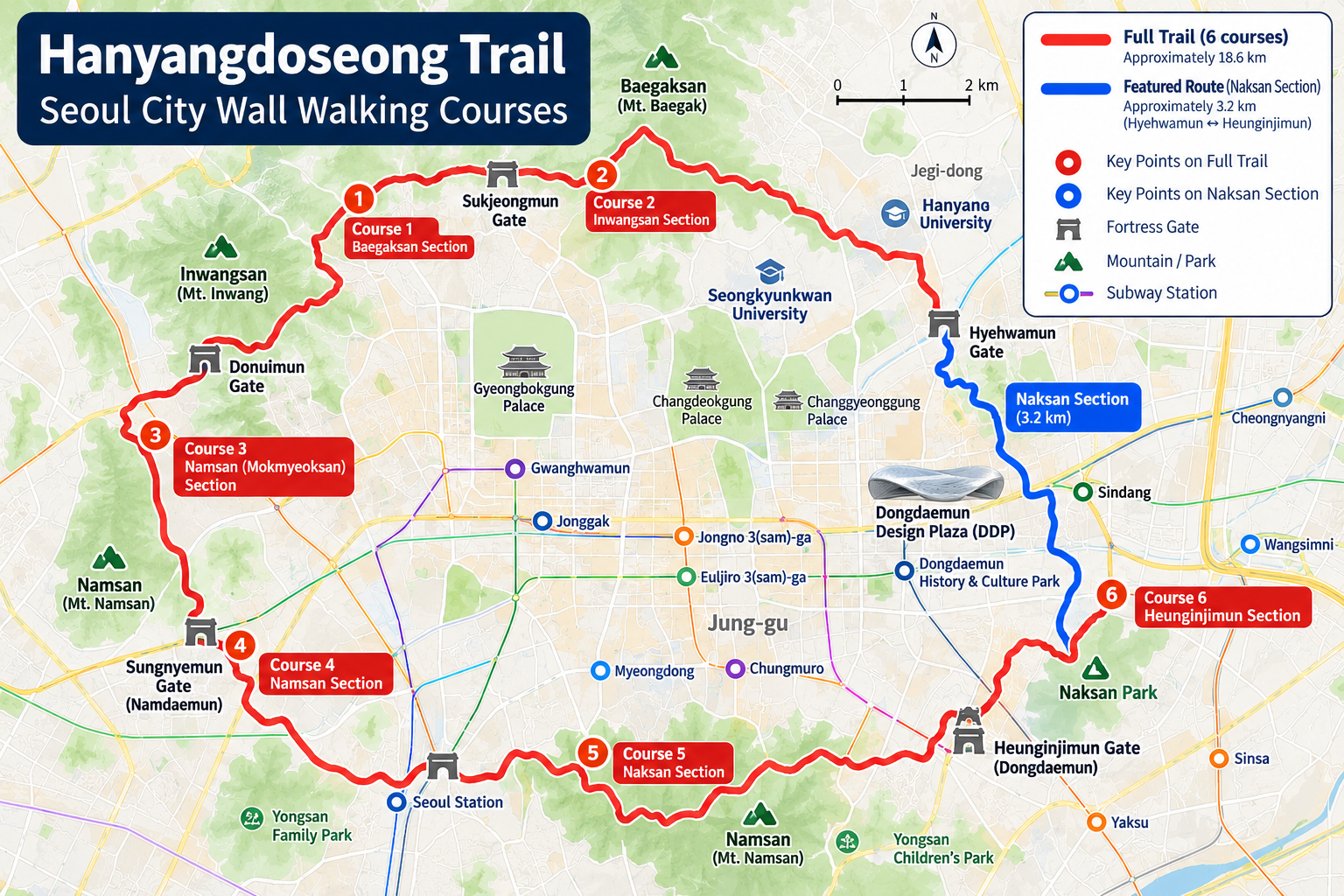
hanyangdoseong trail
Looking for a beautiful night walk in Seoul that combines history, city lights, and a little romance?
The Hanyangdoseong Trail, also known as the Seoul City Wall Trail, is one of the most memorable walking experiences in the Korean capital.
While Seoul is famous for busy shopping streets, skyscrapers, and nightlife districts, the ancient fortress wall offers something different: a peaceful walking route overlooking the modern city.
One particularly scenic route begins near Dongdaemun Design Plaza (DDP), passes the historic Heunginjimun Gate, and follows the old city wall uphill toward Naksan Park.
As the sun sets, the surrounding buildings begin to glow, the stone walls are illuminated, and the city skyline gradually appears beyond the hillside.
Whether you are planning a romantic date, an evening photography walk, or a relaxing outdoor activity, this route is worth adding to your Seoul itinerary.
1. Hanyangdoseong Trail at a Glance
| Information | Details |
|---|---|
| Trail name | Hanyangdoseong Trail (Seoul City Wall Trail) |
| Korean name | 한양도성길 |
| Featured route | DDP → Heunginjimun Gate → Naksan Park |
| Official Naksan section | Hyehwamun Gate → Heunginjimun Gate |
| Official section length | 3.2 km |
| Official section walking time | Approximately 1 hour |
| Suggested evening itinerary | Allow approximately 1–2 hours including DDP and photo stops |
| Difficulty | Easy to moderate, with uphill sections |
| Naksan Park admission | Free |
| Naksan Park opening hours | 24 hours |
| Recommended season | Spring and autumn |
| Best time for city views | Around sunset and after dark |
| Nearest subway stations | Dongdaemun and Hyehwa, Line 4 |
The 3.2 km figure refers to the full official Naksan Mountain Trail, not the shorter walk from Heunginjimun Gate to Naksan Park.
Walking time varies depending on your starting point, pace, and how often you stop to take photographs.
2. What Is the Hanyangdoseong Trail?
Hanyangdoseong is the historic fortress wall built to protect Hanyang, the capital of the Joseon Dynasty.
Construction began in 1396 during the reign of King Taejo, the founder of Joseon.
The wall stretches approximately 18.6 kilometers and follows the natural landscape around central Seoul.
It passes along four historically important mountains:
- Baegaksan (Bugaksan)
- Naksan
- Namsan (Mongmyeoksan)
- Inwangsan
These mountains once formed the natural boundaries of the old capital.
The wall was designed not only as a defensive structure but also as a physical and symbolic boundary of the city.
Why Is the Seoul City Wall Special?
Unlike many historical sites that are separated from modern urban life, Hanyangdoseong remains closely connected to everyday Seoul.
Parts of the wall stand beside residential neighborhoods, cafés, roads, and modern buildings.
Walking along it allows visitors to experience two very different periods of Korean history at the same time.
On one side, you see centuries-old stonework.
On the other, you see apartment buildings, illuminated streets, office towers, and the modern Seoul skyline.
Understanding the Different Trail Sections
Hanyangdoseong is not a single short walking path.
The full historic wall measures approximately 18.6 kilometers, and visitors can explore different sections separately.
The Naksan section is particularly attractive to casual walkers because it has relatively gentle slopes compared with some of Seoul’s more mountainous routes.
The official Seoul City Wall website identifies the Naksan Mountain Trail as a 3.2 km route between Hyehwamun Gate and Heunginjimun Gate.
This guide focuses on the Heunginjimun-to-Naksan-Park portion, with an optional starting point at DDP.
3. Start Your Evening Walk at Dongdaemun Design Plaza (DDP)
Dongdaemun Design Plaza, commonly called DDP, is one of Seoul’s most recognizable contemporary architectural landmarks.
Its futuristic appearance creates an interesting contrast with the traditional city wall nearby.
DDP is a cultural complex known for exhibitions, design events, fashion programs, and public spaces.
Why Visit DDP Before the Trail?
Starting at DDP makes the evening walk more varied.
You can begin with modern architecture, continue through the bustling Dongdaemun commercial district, and then move toward the historic fortress wall.
Around sunset, the outdoor spaces near DDP can be especially attractive for photography.
The building’s curved surfaces, surrounding city lights, and open spaces provide opportunities for interesting photographs.
How to Get to DDP
Take the subway to Dongdaemun History & Culture Park Station, served by Lines 2, 4, and 5.
Follow station signs toward Dongdaemun Design Plaza.
After exploring DDP, head north toward Heunginjimun Gate.
The area is busy, so use designated pedestrian crossings when moving between major roads.
4. Heunginjimun Gate: Seoul’s Historic East Gate
Heunginjimun Gate, often called Dongdaemun, is one of the most important landmarks along this walking route.
The gate originally formed part of the capital’s defensive system during the Joseon Dynasty.
It was first built in 1398, during the reign of King Taejo.
The present structure dates to 1869, when it was rebuilt during the reign of King Gojong.
What Makes Heunginjimun Unique?
Heunginjimun is especially notable for its traditional two-story gate pavilion and its defensive outer wall.
The gate features a protective semicircular structure known as an ongseong, which was designed to strengthen the defense of the main entrance.
It is one of the most distinctive surviving examples of Joseon-era gate architecture in Seoul.
Heunginjimun is officially designated as a Treasure of South Korea.
Why Visit at Night?
During the evening, lighting highlights the roof structure, decorative details, and stone foundations.
The illuminated gate contrasts beautifully with modern commercial buildings and surrounding roads.
For photographers, this is a good place to capture traditional Korean architecture against the city skyline.
Photography tip: Try including the entire gate and part of the surrounding city in your composition to emphasize the contrast between historic and modern Seoul.
5. Walking from Heunginjimun to Naksan Park
After exploring Heunginjimun Gate, continue toward the Naksan section of the Seoul City Wall.
This is where the atmosphere begins to change.
The busy streets around Dongdaemun gradually give way to a quieter hillside walking path.
You will follow the historic fortress wall as it climbs toward Naksan Park.
What Is the Walking Path Like?
The route includes paved walkways, gradual uphill slopes, and sections beside the old city wall.
Although Naksan is one of Seoul’s lower mountains, walking uphill can still require moderate effort.
The walk is generally manageable for reasonably mobile visitors wearing comfortable shoes.
However, travelers with limited mobility should check accessible routes in advance.
Inside and Outside the City Wall
One interesting feature of Hanyangdoseong is the difference between the paths on the inner and outer sides of the wall.
The inner route faces the historical city center.
The outer route offers views toward neighborhoods beyond the original capital boundary, including parts of Changsin-dong.
Both sides offer different perspectives, but not every section allows immediate passage between them.
Follow official walking paths and designated access points.
Watching the Skyline Change
As you climb, the city becomes more visible.
Near the lower sections, Heunginjimun and Dongdaemun’s commercial buildings remain prominent.
Higher up, the view opens toward surrounding hills, apartment neighborhoods, and central Seoul.
The gradual change in perspective is one of the reasons this walk feels rewarding.
Instead of reaching one viewpoint immediately, you discover new scenes as you move along the trail.
6. Naksan Park: One of Seoul’s Best Night View Spots
Naksan Park is the highlight of this evening itinerary.
Located on Naksan Mountain, the park overlooks central Seoul and preserves part of the historic city wall.
At night, the illuminated stone wall creates a striking foreground against the city lights.
Why Is It Called Naksan?
The mountain is associated with several historical names.
Naksan is sometimes called Naktasan, or Camel Mountain, because its ridgeline was thought to resemble the humps of a camel.
It has also been associated with the name Taraksan, linked to the area’s historical connection with milk production or supply.
The mountain reaches approximately 124 meters above sea level according to the official Seoul City Wall trail information.
Although relatively low, it offers impressive views because of its position near the center of Seoul.
The Best Views at Naksan Park
Different viewpoints reveal different parts of the city.
From some positions, you can see the illuminated city wall extending along the ridge.
Other viewpoints overlook Changsin-dong, downtown Seoul, and distant hills.
The combination of traditional stonework and modern city lights makes the area particularly attractive for nighttime photography.
Is Naksan Park Free?
Yes.
Naksan Park is free to enter.
According to Seoul’s official tourism information, the park is open 24 hours a day.
This makes it convenient for visitors who prefer evening walks after dinner.
However, visitors should stay on designated paths and observe any temporary access restrictions or safety notices.
7. Ihwa-dong: A Charming Neighborhood Along the Trail
One of the enjoyable aspects of the Naksan area is the surrounding neighborhood.
Ihwa-dong is known for its hillside streets, small cafés, restaurants, and residential buildings.
The neighborhood has become a popular destination for people looking for a different side of Seoul.
Small Cafés and Hillside Streets
As you walk near the city wall, you may encounter small cafés and buildings overlooking the city.
Some offer outdoor seating or scenic views.
However, individual opening hours vary, and not every business remains open late.
If you plan to stop for a drink or dessert, check operating hours before visiting.
Respect the Residential Neighborhood
Ihwa-dong is not simply a tourist attraction.
It is also a residential community.
Visitors should avoid blocking narrow streets, photographing private homes intrusively, or making excessive noise at night.
The same applies to sections of the Naksan trail near residential buildings.
Enjoying the scenery while respecting local residents helps preserve the area’s atmosphere.
8. Best Time to Walk the Hanyangdoseong Trail
The trail can be enjoyed throughout the year, but different seasons offer different experiences.
| Season | Advantages | Things to Consider |
|---|---|---|
| Spring | Mild weather and seasonal flowers | Popular walking periods can be busy |
| Summer | Green scenery and long daylight hours | Heat, humidity, and occasional heavy rain |
| Autumn | Comfortable walking temperatures and clear evening atmosphere | Cooler temperatures after sunset |
| Winter | Crisp night views and quieter periods | Cold winds, icy surfaces, and shorter days |
Why Autumn Is Especially Beautiful
Autumn is particularly well suited to this walking route.
Cooler evenings make the uphill sections more comfortable, while the changing colors of the surrounding vegetation add interest to the landscape.
The atmosphere can feel especially pleasant around sunset, when the sky darkens and the city lights begin to appear.
Sunset vs Nighttime
For photography, arriving before sunset can give you two different experiences.
First, you can enjoy the city wall in natural light.
Then, as the sky becomes darker, you can photograph the illuminated wall and the surrounding skyline.
For visitors planning a romantic evening walk, the period around sunset is a particularly attractive choice.
9. Is Naksan Park a Good Place to See the Chuseok Moon?
Chuseok is Korea’s major autumn harvest holiday.
Traditionally, the full moon is an important symbol associated with the holiday.
Naksan Park can be a pleasant place to enjoy the evening sky during the Chuseok period, especially when conditions are clear.
The hillside location offers relatively open views in some directions, although buildings, terrain, clouds, and the moon’s position can affect visibility.
Tips for Moon Viewing
Check the moonrise time and weather forecast before visiting.
The best position for observing the moon will depend on its location in the sky that evening.
Avoid assuming that the same viewpoint will offer an unobstructed moon view every year.
Bring a light jacket, since temperatures can drop after sunset during autumn.
Naksan Park is not an official astronomical observation facility, but it can provide a scenic setting for enjoying an autumn evening.
10. How to Get to Naksan Park
Several public transportation options provide access to the Naksan area.
Option 1: Walk from Dongdaemun Station
Take Subway Line 1 or 4 to Dongdaemun Station.
From the station, walk toward Heunginjimun Gate and follow the Naksan section of Seoul City Wall.
This is a good choice for visitors who want to experience the full uphill approach.
Option 2: Walk from Hyehwa Station
Take Subway Line 4 to Hyehwa Station.
Use Exit 2 and follow pedestrian directions toward Naksan Park.
According to Seoul’s official tourism information, the park is roughly a ten-minute walk from the station area, although the time depends on the entrance you choose.
This approach is convenient for travelers who want to explore the Daehangno cultural district before or after the park.
Option 3: Use a Local Bus
Seoul’s tourism guides have also identified Jongno village bus 03 as an option for reaching the Naksan area.
Bus routes and stop locations can change, so verify the latest route using a local transit app before traveling.
What About Parking?
Naksan Park has limited parking capacity.
Visit Seoul’s parking information has listed approximately 29 spaces, with historical parking charges of ₩300 per ten minutes as of 2024.
Because that fee is not a verified 2026 rate, visitors should confirm current charges before driving.
During weekends and holidays, public transportation is generally the more convenient option.
11. Suggested Hanyangdoseong Evening Walking Itinerary
For first-time visitors, the following route combines modern architecture, Korean history, and nighttime scenery.
| Stop | Location | What to Do |
|---|---|---|
| 1 | Dongdaemun Design Plaza | Explore contemporary architecture and take photographs |
| 2 | Heunginjimun Gate | View the historic east gate and its evening illumination |
| 3 | Naksan City Wall Path | Walk uphill beside the fortress wall |
| 4 | Naksan Park | Enjoy panoramic night views |
| 5 | Ihwa-dong or Daehangno | Finish with a café, meal, or neighborhood walk |
Suggested Timing
Allow approximately 1–2 hours for the walking and sightseeing portion, depending on your starting point and pace.
If you plan to visit exhibitions at DDP, eat dinner, or explore several cafés, allow additional time.
The route is particularly appealing for couples, but it also works well for solo travelers and small groups.
A Shorter Alternative
If you do not want to walk uphill from Dongdaemun, approach Naksan Park from Hyehwa Station or use an available local bus connection.
You can still enjoy a section of Seoul City Wall without completing the full official Naksan Mountain Trail.
12. Practical Tips for a Night Walk
Wear Comfortable Walking Shoes
Although the Naksan route is not a major mountain hike, it includes slopes and some uneven sections.
Comfortable shoes with good grip are recommended.
Bring Water
Carry drinking water, especially during warmer months.
There may be cafés and shops in nearby neighborhoods, but their opening hours are not guaranteed.
Use Caution After Dark
Stay on official walking routes and pay attention to changes in elevation.
Avoid unlit shortcuts, closed stairways, and slippery surfaces after rain.
Keep Noise Low
Some parts of the trail are close to residential neighborhoods.
Speak quietly, particularly late in the evening.
Check the Weather
Rain, strong winds, snow, and icy conditions can affect safety and visibility.
For the best night views, choose a day with favorable weather and clear skies.
13. Frequently Asked Questions
1. How long is the Hanyangdoseong Trail?
The complete historic Seoul City Wall measures approximately 18.6 kilometers. The official Naksan Mountain Trail between Hyehwamun and Heunginjimun is approximately 3.2 kilometers, with an estimated walking time of one hour.
2. Can you walk the Hanyangdoseong Trail at night?
The official Naksan section is listed as open 24 hours, and Naksan Park also operates around the clock. However, other sections of Seoul City Wall may have different access arrangements, so check the specific course before visiting.
3. Is Naksan Park free to enter?
Yes. Naksan Park has free admission and is open 24 hours a day.
4. Is the trail suitable for beginners?
The Naksan section is generally manageable for beginners and casual walkers, although it includes uphill slopes. Visitors with mobility limitations should check accessible routes before traveling.
5. What is the best subway station for the Hanyangdoseong Trail?
For the Dongdaemun-to-Naksan walking route, Dongdaemun Station on Lines 1 and 4 is a convenient starting point. Hyehwa Station on Line 4 is another useful option for approaching Naksan Park.
14. Final Thoughts: Is the Hanyangdoseong Trail Worth Visiting?
The Hanyangdoseong Trail offers a combination of history, urban scenery, and quiet outdoor exploration that is difficult to find elsewhere in central Seoul.
Walking from Dongdaemun toward Naksan Park allows you to experience the contrast between modern Seoul and the former capital of the Joseon Dynasty.
DDP introduces the modern city.
Heunginjimun Gate reveals its historic architecture.
The fortress wall leads uphill toward panoramic views.
And Naksan Park provides a peaceful place to enjoy the illuminated skyline.
For couples looking for an evening date, photographers interested in Seoul’s night views, or travelers seeking a free walking activity, this is an excellent option.
The best way to enjoy the route is to arrive before sunset, walk at a comfortable pace, and allow time to appreciate the city as its lights come on.
Last updated: October 18, 2026. Walking times are estimates. Trail access, transport services, and weather conditions should be checked before visiting.