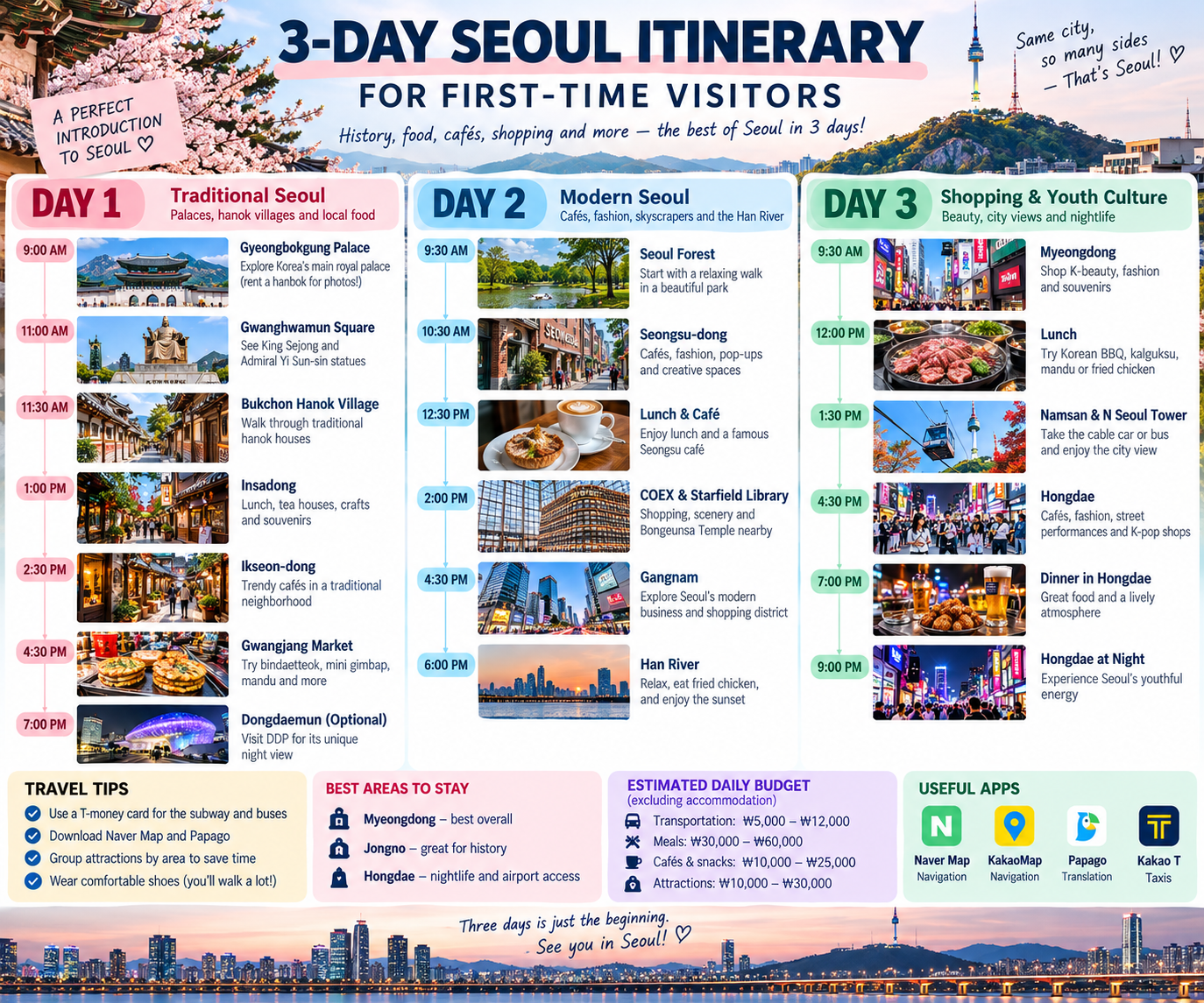
3-Day Seoul Itinerary for First-Time Visitors
Three days in Seoul is short.
But it is enough to experience the city’s essential mix of:
- Korean history
- Traditional neighborhoods
- Street food
- K-beauty
- Shopping
- Modern cafés
- Nightlife
- The Han River
The biggest mistake is trying to visit every famous neighborhood.
Seoul is enormous.
With only three days, location and route planning matter more than the number of attractions on your list.
This itinerary groups places geographically so you spend more time exploring and less time sitting on the subway.
3-Day Seoul Itinerary at a Glance
| Day | Theme | Main Stops |
|---|---|---|
| Day 1 | Traditional Seoul | Gyeongbokgung, Bukchon, Insadong, Gwangjang Market |
| Day 2 | Modern Seoul | Seongsu, Seoul Forest, COEX, Gangnam, Han River |
| Day 3 | Shopping & Youth Culture | Myeongdong, N Seoul Tower, Hongdae |
This structure gives you a useful cross-section of Seoul without excessive backtracking.
Day 1: Gyeongbokgung, Bukchon, Insadong and Gwangjang Market
Your first full day should focus on Seoul’s historic center.
Most of today’s attractions are relatively close to one another.
That is exactly what you want on a three-day trip.
9:00 AM — Gyeongbokgung Palace
Start at Gyeongbokgung Palace.
This is the main royal palace most first-time visitors should see.
Seoul’s official tourism materials consistently place Gyeongbokgung and the Gwanghwamun area among the city’s essential first-visit attractions.
Allow around:
1.5 to 2 hours
If you want the full experience, rent a hanbok near the palace.
Traditional clothing also makes for excellent photos around the palace grounds.
11:00 AM — Gwanghwamun Square
Walk through Gwanghwamun Square.
You’ll see statues of:
- King Sejong
- Admiral Yi Sun-sin
and get a wide view back toward Gyeongbokgung and the surrounding mountains.
You don’t need hours here.
Think of it as a transition between the palace and the rest of central Seoul.
11:30 AM — Bukchon Hanok Village
Continue toward Bukchon Hanok Village.
Bukchon is one of the best places to see Seoul’s traditional hanok houses.
But remember:
This is not just a tourist attraction.
People live here.
Keep your voice down and follow any visitor restrictions in residential areas.
Seoul’s official first-visitor guide includes Bukchon among the city’s representative destinations.
1:00 PM — Lunch in Insadong
Walk toward Insadong.
This is a good place for your first traditional Korean lunch.
Try:
- Bibimbap
- Bulgogi
- Mandu
- Korean set meals
- Pajeon
After lunch, explore:
- Craft shops
- Tea houses
- Ceramics
- Souvenir stores
Insadong is a much better place than the airport for buying traditional-looking gifts.
2:30 PM — Ikseon-dong
Walk toward nearby Ikseon-dong.
This neighborhood combines traditional hanok architecture with:
- Modern cafés
- Dessert shops
- Restaurants
- Small boutiques
Have coffee here.
Three-day itineraries often become too aggressive.
A café break is not wasted time.
It’s part of experiencing Seoul.
4:30 PM — Gwangjang Market
Head to Gwangjang Market.
The market is one of the most famous traditional-food stops in central Seoul and is particularly known for items such as mung-bean pancakes and gimbap.
Try:
Bindaetteok
Mung bean pancake.
Mini gimbap
Small rice rolls.
Mandu
Dumplings.
Tteokbokki
Spicy rice cakes.
Yukhoe
Seasoned raw beef, if you’re comfortable eating raw meat.
Don’t order a full meal at the first stall.
Share several smaller dishes if you’re traveling with someone.
7:00 PM — Optional Dongdaemun and DDP
If you still have energy, continue to:
Dongdaemun Design Plaza (DDP)
Seoul’s official beginner itinerary pairs Gwangjang Market and DDP in the same central-Seoul sightseeing sequence.
DDP is especially interesting after dark.
If you’re exhausted, skip it.
Three days in Seoul is a marathon, not an audition for an endurance sport.
Day 1 Route
Gyeongbokgung → Gwanghwamun → Bukchon → Insadong → Ikseon-dong → Gwangjang Market → optional DDP
This is your traditional Seoul day.
Day 2: Seongsu, Gangnam and the Han River
Day 2 is almost the opposite of Day 1.
Today is about modern Seoul.
You’ll move through cafés, Korean fashion, design, skyscrapers and the Han River.
9:30 AM — Seoul Forest
Start at Seoul Forest.
The park gives you a slower morning before nearby Seongsu becomes busier.
Walk for about an hour.
10:30 AM — Seongsu-dong
Continue into Seongsu.
Former industrial buildings in this neighborhood have been transformed into:
- Cafés
- Fashion boutiques
- Pop-up stores
- K-beauty shops
- Restaurants
- Design spaces
Seoul’s official itineraries now pair Seoul Forest and Seongsu-dong as a destination area for visitors interested in contemporary local culture.
This matters because a first trip shouldn’t be only palaces and markets.
Seongsu shows you what current Seoul feels like.
12:30 PM — Lunch and Café in Seongsu
Have lunch here.
Then visit one café.
Not seven.
Seongsu has an impressive ability to turn a simple coffee stop into half a day.
Plan accordingly.
2:00 PM — COEX and Starfield Library
Take the subway south to Samseong Station.
Visit:
- COEX Mall
- Starfield Library
- Bongeunsa Temple
The official Seoul tourism guides include COEX and nearby Gangnam-area attractions in recommended beginner itineraries.
The combination is particularly good because you can see:
modern megamall
and
traditional Buddhist temple
within the same neighborhood.
Very Seoul.
4:30 PM — Gangnam
Continue to Gangnam Station.
You don’t need to spend an entire afternoon here.
Explore the commercial area and grab a snack or coffee.
Gangnam is worth seeing on a first trip, but with only three days, I would not give it more time than historic central Seoul.
6:00 PM — Han River
Finish the day beside the Han River.
Good options include:
- Banpo Hangang Park
- Yeouido Hangang Park
- Ttukseom Hangang Park
Depending on where you finish your afternoon, choose the riverside park that minimizes travel.
Seoul’s official first-time itineraries repeatedly include Hangang parks as a signature visitor experience.
What to Do at the Han River
Buy:
- Fried chicken
- Convenience-store ramen
- Snacks
- Drinks
Then sit down and watch the skyline.
This is one of the few times in this itinerary when the correct activity is:
nothing.
Just stay there.
Day 2 Route
Seoul Forest → Seongsu → COEX → Gangnam → Han River
This is your modern Seoul day.
Day 3: Myeongdong, N Seoul Tower and Hongdae
Your final day combines shopping, city views and Seoul’s youthful nightlife.
9:30 AM — Myeongdong
Start in Myeongdong.
Seoul’s tourism authority describes it as one of central Seoul’s major shopping districts, with department stores, global brands, duty-free shopping and street food.
If you’re interested in:
- K-beauty
- Korean skincare
- Cosmetics
- Fashion
- Souvenirs
this is the morning to shop.
What to Buy in Myeongdong
Popular categories include:
- Korean sunscreen
- Sheet masks
- Cleansers
- Serums
- Makeup
- Snacks
If you’re buying a lot of skincare, compare prices instead of buying everything at the first store.
12:00 PM — Lunch
Eat around Myeongdong.
Good first-trip options include:
- Korean BBQ
- Kalguksu
- Mandu
- Bulgogi
- Fried chicken
Try not to spend the entire trip chasing viral restaurants.
A busy local restaurant with a short menu is often just as good.
1:30 PM — Namsan and N Seoul Tower
Head toward Namsan.
You can go up using:
- Cable car
- Bus
- Walking route
Visit N Seoul Tower.
Seoul’s official beginner itineraries consistently recommend Namsan and the tower for first-time sightseeing.
If the weather is clear, you’ll get a broad view over Seoul.
4:30 PM — Head to Hongdae
Take the subway to Hongik University Station.
Hongdae gives your final day a completely different atmosphere.
The Mapo area is known for youth culture, street performances, art and creative energy.
Explore:
- Fashion shops
- Cafés
- Photo booths
- K-pop stores
- Street performances
- Restaurants
7:00 PM — Dinner in Hongdae
Good choices include:
Korean Fried Chicken
or
Korean BBQ
or
Dakgalbi
If your flight leaves from Incheon Airport the next day, Hongdae also has the advantage of direct AREX All-Stop access from Hongik University Station.
9:00 PM — Hongdae at Night
Stay for the evening.
You don’t need to go clubbing to enjoy Hongdae.
Simply walk around.
At night you’ll see:
- Street performers
- Karaoke
- Bars
- Late-night restaurants
- Busy shopping streets
Seoul’s official itinerary also uses Hongik University as a key final stop in first-time visitor routes.
Day 3 Route
Myeongdong → N Seoul Tower → Hongdae
This is your shopping + nightlife day.
The Full 3-Day Seoul Route
Day 1 — History
Gyeongbokgung
↓
Bukchon
↓
Insadong
↓
Ikseon-dong
↓
Gwangjang Market
Day 2 — Modern Seoul
Seoul Forest
↓
Seongsu
↓
COEX
↓
Gangnam
↓
Han River
Day 3 — Shopping and Culture
Myeongdong
↓
N Seoul Tower
↓
Hongdae
This gives you a surprisingly complete introduction to Seoul in three days.
Where Should You Stay for This Itinerary?
With only three days, hotel location matters a lot.
My preferred areas are:
1. Myeongdong
Best overall.
Why?
Central location and convenient access to many sightseeing areas.
2. Jongno
Best for history.
Ideal if Day 1 is your priority.
3. Hongdae
Best for:
- Younger travelers
- Nightlife
- Airport access
Where I Would NOT Stay for This Particular Trip
If you only have three days and this is your first visit, I would generally not choose an outer Seoul neighborhood just to save a small amount on the hotel.
You will lose too much time commuting.
Likewise, Gangnam can be an excellent place to stay, but it is less efficient if most of your must-see attractions are north of the Han River.
How Much Transportation Will You Need?
Most trips can be made by subway.
Use:
T-money
and install:
Naver Map
or
KakaoMap
before your trip.
Seoul’s subway system is extensive, but the real secret isn’t mastering the whole network.
It’s grouping neighborhoods correctly.
What If It Rains?
Swap outdoor activities for:
- COEX
- Starfield Library
- Museums
- Myeongdong shopping
- Cafés
- DDP
Move the Han River and Seoul Forest to the clearest day.
With a three-day itinerary, some flexibility is essential.
What Should You Skip With Only Three Days?
This is important.
I would generally skip:
- Jeju
- Busan day trip
- Gyeongju day trip
- Far suburban attractions
Three days is barely enough for Seoul itself.
Do not turn your trip into a tour of Korean train stations.
Should You Add the DMZ?
You can, but something has to go.
A DMZ tour can consume a significant portion of a day.
If the DMZ is a major personal interest, replace most of Day 2 or Day 3 with the tour.
Don’t try to squeeze it into an already packed day.
Should You Visit Lotte World?
If Lotte World is one of your main reasons for visiting Seoul, absolutely.
But it requires serious time.
For a generic first three-day trip, I’d prioritize:
- Palaces
- Markets
- Neighborhoods
- Han River
- Seoul city culture
and save Lotte World for a longer stay.
Is Three Days Enough in Seoul?
Yes—
but only if you accept that you won’t see everything.
Three days is enough to experience:
- Joseon history
- Traditional architecture
- Korean markets
- Korean food
- K-beauty
- Shopping
- Modern Seoul
- Han River culture
- Youth nightlife
That’s a very good first introduction.
Four or five days is better.
But three days is absolutely worthwhile.
3-Day Seoul Budget
Excluding accommodation and shopping, a rough daily budget might look like:
| Item | Approximate Daily Cost |
|---|---|
| Subway/bus | ₩5,000–₩12,000 |
| Meals | ₩30,000–₩60,000 |
| Coffee/snacks | ₩10,000–₩25,000 |
| Attractions | ₩10,000–₩30,000 |
You can spend considerably more on:
- Fine dining
- K-beauty
- Fashion
- Nightlife
Seoul is very good at presenting you with things you didn’t know you needed.
Essential Apps
Before leaving the airport, install:
Naver Map
Best all-around navigation tool.
KakaoMap
Useful alternative.
Papago
Translation.
Kakao T
Taxi booking.
You don’t need an entire folder of Korean apps.
Those four cover most tourist situations.
Common 3-Day Seoul Mistakes
Mistake 1: Trying to Visit Too Many Neighborhoods
Four neighborhoods per day sounds efficient on paper.
It isn’t.
Mistake 2: Crossing the Han River Repeatedly
Group southern Seoul activities together.
Mistake 3: Ignoring Subway Transfer Time
A 30-minute train trip can become 50 minutes after walking and transfers.
Mistake 4: Visiting Only Tourist Attractions
Make time for:
- Cafés
- Markets
- Neighborhood streets
- Han River
Mistake 5: Shopping Too Early
If you buy a suitcase full of skincare on Day 1, congratulations.
You now get to carry your shopping for the rest of the trip.
Save some shopping for the final day.
Frequently Asked Questions
What should I do with 3 days in Seoul?
For a first visit, divide your time into:
Day 1: Historic Seoul
Day 2: Modern Seoul
Day 3: Shopping and youth culture
This gives you the widest variety without excessive travel.
Is 3 days too short for Seoul?
No.
Three days is short but worthwhile.
Four to five days is more comfortable, but a properly planned three-day itinerary can cover many of Seoul’s highlights.
Should I spend more time in Myeongdong or Hongdae?
Choose Myeongdong if you prioritize shopping and sightseeing.
Choose Hongdae if you prioritize nightlife, cafés and younger culture.
Can I visit Gyeongbokgung and Bukchon on the same day?
Yes.
You should.
They are close enough to combine with Insadong and central Seoul attractions.
Should I rent a car?
No.
For this itinerary, a car would be more trouble than help.
Use:
- Subway
- Bus
- Taxi when necessary
Where is the best place to stay for only three days?
For most first-time visitors:
Myeongdong
or
Jongno
offers the most efficient sightseeing location.
Hongdae is also excellent if airport access and nightlife are priorities.
Final Thoughts
Three days in Seoul shouldn’t feel like a competition to collect landmarks.
Think of the trip as three different versions of the city.
On Day 1, see the Seoul of kings, palaces and hanok neighborhoods.
On Day 2, experience the Seoul of fashion, cafés, skyscrapers and the Han River.
On Day 3, shop, look over the city from Namsan and finish your trip among the energy of Hongdae.
You will miss places.
That’s normal.
Seoul is a city worth returning to.
The goal of your first three days isn’t to finish Seoul.
It’s to understand why you want to come back.