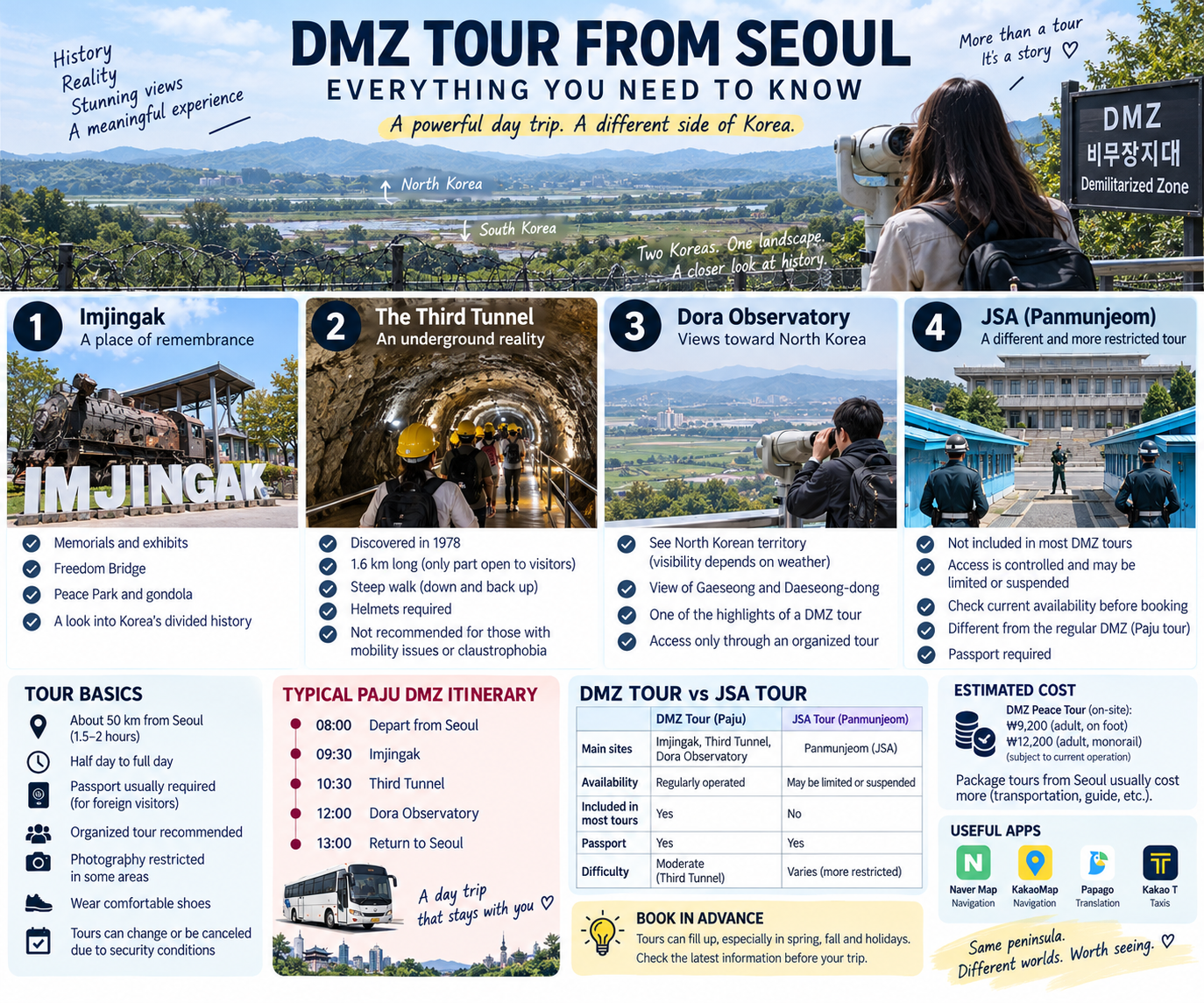
DMZ Tour from Seoul: Everything You Need to Know
A DMZ tour is one of the most unusual day trips you can take from Seoul.
Less than two hours from the center of one of Asia’s biggest cities, you can visit an area shaped directly by the Korean War and the continuing division of the Korean Peninsula.
For many American visitors, a DMZ tour is especially meaningful because of the United States’ role in the Korean War and the continuing U.S. military presence in South Korea.
But DMZ tours can also be confusing.
You may see tours advertising:
- The Third Tunnel
- Dora Observatory
- Imjingak
- Freedom Bridge
- Unification Village
- Camp Greaves
- Panmunjeom
- JSA
These are not all the same thing.
The most common first-time visitor tour from Seoul is the Paju DMZ tour, usually centered on:
Imjingak → Third Tunnel → Dora Observatory
That is the itinerary this guide focuses on.
DMZ Tour at a Glance
| Item | What to Know |
|---|---|
| Best for | History, Korean War, geopolitics |
| Distance from Seoul | About 50 km north |
| Typical duration | Half day to full day |
| Passport | Usually required |
| Individual access | Limited |
| Main attractions | Imjingak, Third Tunnel, Dora Observatory |
| JSA included? | Usually no |
| Photography | Restricted in some areas |
| Walking difficulty | Moderate at Third Tunnel |
The Third Tunnel is about 52 km from Seoul and is the closest of Korea’s discovered infiltration tunnels to the capital. VISITKOREA – Imagine Your Korea
What Is the DMZ?
DMZ stands for:
Demilitarized Zone
It was created after the Korean Armistice Agreement was signed on July 27, 1953.
The zone separates North and South Korea and stretches roughly across the Korean Peninsula.
Despite the name “demilitarized,” it is one of the most politically sensitive borders in the world.
Because civilian access has been heavily restricted for decades, parts of the area have also become important wildlife habitats. VISITKOREA – Imagine Your Korea
Is the DMZ the Border?
Not exactly.
This is an important distinction.
The actual military dividing line is the:
Military Demarcation Line, or MDL
The DMZ extends approximately two kilometers on each side of that line.
Tourists generally remain on the South Korean side in controlled visitor areas.
You are not simply walking freely along the border.
What Is the Best DMZ Tour From Seoul?
For most first-time visitors, choose a Paju DMZ tour that clearly includes:
- Imjingak
- The Third Tunnel
- Dora Observatory
These attractions are relatively close together and are among the easiest DMZ sites to reach from Seoul. VISITKOREA – Imagine Your Korea
Before booking, read the itinerary rather than relying only on the words:
“DMZ Tour”
Korea has several DMZ tourism regions, including Paju and Cheorwon.
A Cheorwon tour may include the Second Tunnel, not the Third Tunnel.
1. Imjingak
Most Paju DMZ tours begin around Imjingak.
Imjingak is south of the Civilian Control Line and contains several memorial and tourism facilities.
You can see:
- Korean War memorials
- Freedom Bridge
- Peace-related exhibits
- Mangbaedan altar
- Peace Gondola
- Military relics
Unlike deeper DMZ sites, Imjingak is comparatively easy to visit.
Think of it as the gateway to the Paju DMZ.
Why Imjingak Matters
Imjingak is not simply a tourist stop.
It developed as a place connected to families separated by the division of Korea.
That historical context is worth understanding before you continue deeper into the controlled area.
If your tour guide provides background here, listen.
It makes the rest of the tour much more meaningful.
2. The Third Tunnel
The Third Tunnel is often the most memorable part of a DMZ tour.
It was discovered in 1978.
According to Korea Tourism Organization information, the tunnel is approximately:
1.6 km long
and around:
2 meters wide. VISITKOREA – Imagine Your Korea
Only part of the tunnel is open to visitors.
Why Was the Third Tunnel Built?
South Korea states that the tunnel was constructed by North Korea for infiltration toward the South.
Its location and capacity made it strategically significant.
Korea Tourism Organization notes estimates that tens of thousands of personnel could theoretically move through the tunnel within an hour. VISITKOREA – Imagine Your Korea
Is the Third Tunnel Difficult to Walk?
This is something travel blogs often understate.
The tunnel itself is not a casual flat stroll.
There is a significant descent and then—
more importantly—
a significant uphill walk back out.
Expect:
- Steep slopes
- Low ceilings in places
- Helmets
- Damp tunnel conditions
- Confined spaces
If you have limited mobility, knee problems, heart or respiratory issues, or severe claustrophobia, consider whether the underground portion is appropriate for you.
There may be alternative viewing options depending on the tour.
How Long Does the Third Tunnel Take?
The official DMZ Peace Tour involving the Third Tunnel is listed at around three hours for the controlled-zone portion of the tour. VISITKOREA – Imagine Your Korea
A full Seoul-based package takes longer because you also need to account for:
- Seoul pickup
- Drive to Paju
- Registration
- Security checks
- Other attractions
- Return to Seoul
Can You Take Photos Inside the Tunnel?
Photography is restricted in sensitive parts of the DMZ.
Do not assume that because you are on a tourist tour you can photograph everything.
Korea Tourism Organization explicitly warns visitors that photography is restricted in DMZ areas. VISITKOREA – Imagine Your Korea
Follow your guide’s instructions.
If a sign says:
No Photography
don’t test the rule.
3. Dora Observatory
Dora Observatory is one of the highlights of the Paju DMZ tour.
From the observatory, depending on visibility, visitors may be able to see:
- The DMZ landscape
- Daeseong-dong village
- North Korean farmland
- Gaeseong
- Mountains on the North Korean side
Korea Tourism Organization describes Dora Observatory as the closest DMZ observatory to Panmunjeom. VISITKOREA – Imagine Your Korea
What Will You Actually See?
Do not expect something dramatic like soldiers facing each other across a few feet of concrete.
That’s more associated with the JSA.
At Dora Observatory, the experience is more about distance and geography.
You’ll look across one of the world’s most politically significant borders.
On clear days, the view can be impressive.
On foggy or rainy days, visibility can be poor.
Weather matters here more than many visitors realize.
Can You Visit Dora Observatory Alone?
No, not normally as an individual walk-in visitor.
Korea Tourism Organization states that individual visits are not permitted and that access is made through the DMZ Peace Tour, typically departing from Imjingak after reservation. VISITKOREA – Imagine Your Korea
Do You Need a Passport for the DMZ?
Yes.
For foreign visitors, this is one of the most important rules.
Bring your actual passport unless your tour operator explicitly provides different current instructions.
Korea Tourism Organization states that visitors entering controlled DMZ locations such as the Third Tunnel and Dora Observatory must present identification such as a passport or residence card. VISITKOREA – Imagine Your Korea
Do not assume a photo on your phone will be enough for every site.
Take the passport.
Can You Visit the DMZ Without a Tour?
Parts of the general border region can be visited independently.
For example, Imjingak itself is relatively accessible.
But sites beyond the Civilian Control Line are much more restricted.
For foreign visitors in particular, an organized tour is usually the simplest and most reliable option. VISITKOREA – Imagine Your Korea
You cannot simply rent a car and drive wherever you want near the border.
What Is the Civilian Control Line?
The Civilian Control Line, often abbreviated:
CCL
is a restricted boundary south of parts of the actual DMZ.
Access beyond it is controlled.
The Third Tunnel and Dora Observatory are among attractions located inside controlled areas.
That is why:
- Identification checks
- Tour registration
- Controlled vehicles
- Security procedures
are part of the experience.
DMZ Tour vs JSA Tour: What’s the Difference?
This is one of the most important sections.
Standard DMZ Tour
Usually includes places such as:
- Imjingak
- Third Tunnel
- Dora Observatory
This is the tour most visitors book.
JSA / Panmunjeom
JSA stands for:
Joint Security Area
It is located at Panmunjeom and is directly associated with armistice negotiations and military interaction between North and South.
This is a much more tightly controlled site.
It is not automatically included in a normal DMZ tour.
Can Tourists Visit the JSA Right Now?
This needs to be checked immediately before booking.
Official tourism information currently describes Panmunjeom as accessible only through approved tour arrangements and requiring valid identification. VISITKOREA – Imagine Your Korea
However, JSA public access has been suspended and reopened at different times due to security, diplomatic, military and health conditions.
So do not book a normal “DMZ tour” expecting that you’ll automatically visit the JSA.
Before paying, verify whether the tour explicitly says:
Panmunjeom / JSA
and whether international visitors are currently being accepted.
Should You Choose a JSA Tour?
If available, the JSA is historically and politically significant.
But it is not necessary for a worthwhile DMZ experience.
For most first-time visitors, the regular:
Third Tunnel + Dora Observatory + Imjingak
tour already provides a strong introduction.
Half-Day or Full-Day DMZ Tour?
Both are common.
Half-Day Tour
Best for:
- Short Seoul trips
- First-time visitors
- Travelers who mainly want the classic DMZ sights
Usually focuses on:
- Imjingak
- Third Tunnel
- Dora Observatory
Full-Day Tour
May add:
- Suspension bridges
- Camp Greaves
- Additional memorials
- Local villages
- Other Paju attractions
Choose full-day only if you’re genuinely interested.
Otherwise a half-day tour is usually enough.
Morning vs Afternoon Tour
I generally prefer:
Morning
for three reasons.
1. More Time Later
You can return to Seoul and still have your evening.
2. Weather
Visibility can sometimes be better earlier, although there is no guarantee.
3. Operational Changes
Security-area tours can be delayed or adjusted.
Going earlier leaves more flexibility.
How Much Does a DMZ Tour Cost?
Commercial Seoul-based DMZ tours vary widely depending on:
- Group size
- Hotel pickup
- Private guide
- Additional attractions
- Meals
- Bridge admission
- Transportation
The controlled-zone entry itself is much less expensive than most packaged tours.
Current Korea Tourism Organization information for the Third Tunnel lists the DMZ Peace Tour admission at approximately:
₩9,200 adult on-foot option
or
₩12,200 adult monorail option, subject to current operation. VISITKOREA – Imagine Your Korea
Commercial tours cost more because you’re paying for transportation and guiding from Seoul.
Should You Book in Advance?
Yes.
Especially during:
- Spring
- Fall
- Weekends
- Korean holidays
- High tourism seasons
The Third Tunnel requires tour reservation/controlled access. VISITKOREA – Imagine Your Korea
Booking ahead also lets you compare exactly what is included.
What Should You Look for When Booking?
Check these items:
Does it include the Third Tunnel?
Does it include Dora Observatory?
Where does it depart in Seoul?
Are entrance fees included?
Is hotel pickup included?
Is it half-day or full-day?
Does it specifically include JSA/Panmunjeom—or not?
Is shopping included as part of the itinerary?
Read the actual schedule.
Not just the tour title.
Avoid Misleading “DMZ” Tour Titles
A tour labeled:
DMZ Tour
might not include the exact sites you expect.
For example, some tours visit:
- Cheorwon
- Paju
- Gimpo
- Other border regions
All can legitimately be called DMZ tours.
If your goal is the famous classic Seoul day trip, look specifically for:
Third Tunnel + Dora Observatory
before booking.
What Should You Wear?
Wear comfortable walking shoes.
This is especially important for the Third Tunnel.
You may encounter:
- Long walking distances
- Slopes
- Outdoor observation areas
- Uneven surfaces
Avoid planning the day around fashionable shoes.
This is not the time.
What Should You Bring?
Bring:
- Passport
- Comfortable shoes
- Water
- Light jacket depending on season
- Phone
- Portable battery
- Small day bag
In summer:
- Sunscreen
- Hat
In winter:
- Warm coat
- Gloves
The border area can feel colder and windier than central Seoul.
Can Children Visit?
Many standard DMZ sites can be visited by families.
However, JSA/Panmunjeom has had separate age and security restrictions.
Current tourism information lists an age restriction for Panmunjeom and does not permit very young children. VISITKOREA – Imagine Your Korea
Check your specific tour before booking.
Is the DMZ Tour Safe?
Tours operate only in areas approved for civilian access.
Visitors travel through designated routes with controlled entry procedures.
However, this is still an active military-security environment.
Tours can change or be canceled with little notice due to:
- Military conditions
- Political developments
- Security issues
- Weather
- Operational restrictions
Follow the guide and military instructions at all times.
Can a DMZ Tour Be Canceled Suddenly?
Yes.
This is worth knowing before you build your entire Seoul trip around it.
Security conditions can change quickly.
Sites or routes can sometimes close with little notice.
If the DMZ is important to you, schedule the tour earlier in your Seoul stay, rather than on your final morning.
That way, you may have another day available if your tour is canceled.
Photography Rules
Follow posted signs and guide instructions carefully.
Some areas:
Photography allowed
Other areas:
Restricted photography
and some locations may limit the direction in which cameras can be used.
Official Korean tourism guidance explicitly notes photography restrictions throughout DMZ visits. 한국관광공사
Don’t argue with the rule.
You’re in a military-controlled area.
Is the DMZ Tour Worth It?
For travelers interested in:
- Korean history
- Korean War
- International relations
- North Korea
- U.S.–Korea history
yes.
It adds context to modern Seoul that you won’t get from shopping districts and palaces alone.
But if your priorities are:
- K-pop
- Shopping
- Cafés
- Food
- Nightlife
and you only have three days in Seoul, it may not be essential.
A DMZ tour uses a significant portion of one day.
Should You Visit the War Memorial First?
This is actually a good idea.
If you have time, visit the War Memorial of Korea before your DMZ tour.
Understanding the basics of:
- Japanese colonial rule
- Division of Korea
- Korean War
- Armistice
makes the DMZ much more meaningful.
Without that context, the tour can feel like a collection of unusual military sites.
A Good Seoul + DMZ Schedule
If you have five days in Seoul:
Day 1
Gyeongbokgung + Bukchon + Insadong
Day 2
Seongsu + Gangnam + Han River
Day 3
Morning DMZ Tour
Return to Seoul
Evening Hongdae or Myeongdong
Day 4
Markets + food + shopping
Day 5
Flexible day
That works much better than squeezing the DMZ into a three-day itinerary.
Can You See North Korea From the DMZ?
Potentially, yes.
From Dora Observatory, visibility can extend into North Korean territory, including areas around Gaeseong depending on conditions. VISITKOREA – Imagine Your Korea
But weather matters.
Fog, rain and air quality can dramatically limit what you see.
Don’t book the trip solely expecting a perfect binocular view into North Korea.
Is the Third Tunnel Actually Inside North Korea?
No.
Visitors remain on the South Korean side.
The accessible section of the tunnel is controlled and blocked before reaching the Military Demarcation Line.
You do not cross into North Korea.
Is the DMZ the Same as the 38th Parallel?
Not exactly.
The 38th parallel was historically important in the original division of Korea after World War II.
The current Military Demarcation Line established after the Korean War does not simply follow the 38th parallel.
This distinction is worth knowing because tourists often use the terms interchangeably.
Best DMZ Tour for First-Time Americans
For a typical American traveler, I would choose:
Half-day Paju DMZ tour
including:
Imjingak
for historical context.
Third Tunnel
for the physical experience.
Dora Observatory
for the view across the border.
That gives you the essential DMZ experience without sacrificing your entire day.
Common DMZ Tour Mistakes
Mistake 1: Forgetting Your Passport
This can ruin your tour.
Bring it.
Mistake 2: Assuming DMZ Means JSA
It doesn’t.
Check the itinerary.
Mistake 3: Booking the Wrong DMZ Region
Make sure the tour includes:
Third Tunnel + Dora Observatory
if that is what you want.
Mistake 4: Underestimating the Tunnel Walk
The uphill walk back out can be tiring.
Mistake 5: Ignoring Photo Restrictions
Follow all photography rules.
Mistake 6: Booking It on Your Final Morning
Security-related cancellation can happen.
Schedule earlier if possible.
Mistake 7: Expecting North Korea to Look Dramatic
Much of what you’ll see is countryside.
The significance is historical and geopolitical.
Not visual spectacle.
Frequently Asked Questions
Do I need my passport for a DMZ tour?
Yes.
Foreign visitors entering controlled areas should carry valid identification, and official tourism guidance specifically lists passports for sites such as the Third Tunnel and Dora Observatory. VISITKOREA – Imagine Your Korea
Can I visit the Third Tunnel without a tour?
Access is controlled, and official tourism information states that the Third Tunnel requires advance tour reservation. VISITKOREA – Imagine Your Korea
Can I visit Dora Observatory by myself?
No.
Official guidance says individual visits are not allowed; it is accessed through the DMZ Peace Tour. VISITKOREA – Imagine Your Korea
Does every DMZ tour include the JSA?
No.
Most standard DMZ tours do not automatically include Panmunjeom/JSA.
Check the itinerary carefully.
Is photography allowed?
Only in approved areas.
Photography restrictions apply in security-sensitive locations. VISITKOREA – Imagine Your Korea
How long is a DMZ tour from Seoul?
A typical packaged trip takes roughly half a day or more.
The controlled Paju DMZ Peace Tour portion itself is listed at about three hours, excluding Seoul transportation. VISITKOREA – Imagine Your Korea
Is the Third Tunnel claustrophobic?
It can feel confined.
The tunnel is narrow, damp and low in areas.
Visitors uncomfortable with enclosed spaces may want to skip the underground portion.
Can the tour be canceled?
Yes.
DMZ access can change because of security and operational conditions.
Always check with your tour provider shortly before departure.
Final Recommendation
If this is your first trip to Korea and you have at least four or five days in Seoul, a DMZ tour is worth considering.
Book a Paju tour that clearly includes:
Imjingak
Third Tunnel
and
Dora Observatory
Bring your passport.
Wear comfortable shoes.
Follow all photography restrictions.
And treat the experience as a historical visit—not an amusement attraction.
For American travelers in particular, the DMZ offers something that Seoul’s palaces, markets and shopping districts cannot:
a direct look at the unresolved history that still shapes modern Korea.