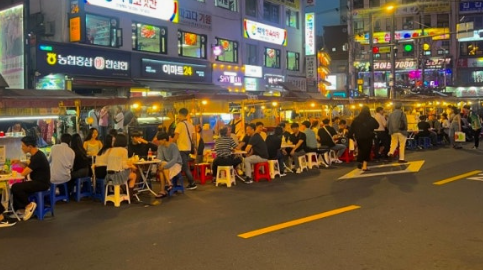
Jongno 3-ga Pocha Street
If you want to experience Seoul nightlife beyond rooftop bars, expensive clubs, and tourist restaurants, Jongno 3-ga Pocha Street is one of the most interesting places to visit.
As evening approaches, outdoor food stalls begin opening around Jongno 3-ga Station. Small tables, colorful lights, Korean street food, and groups of friends sharing soju create an atmosphere that feels distinctly local.
But there is something worth knowing before you go: getting an outdoor table can be harder than finding the street itself.
The area becomes particularly appealing after sunset, when the lights and crowds bring the street to life. That is also when finding a convenient seat may become more difficult.
This guide explains where to go, when to arrive, what to eat, how reservations work, and what to do if the street is crowded.
Jongno 3-ga Pocha Street at a Glance
| Information | What to Know |
|---|---|
| Location | Near Jongno 3-ga Station, central Seoul |
| Neighborhood | Jongno-gu |
| Nearest subway | Jongno 3-ga Station, Lines 1, 3 and 5 |
| Main food-stall area | Around Donhwamun-ro 11-gil |
| Typical evening activity | Stalls begin setting up around 5 PM |
| Best arrival strategy | Arrive around 5–6 PM to improve your chances of finding a table |
| Best atmosphere | After sunset |
| Reservations | Depend on the individual establishment |
| Popular food | Rolled omelet, chicken feet, udon and seafood pancakes |
| Nearby alternatives | Ikseon-dong and Seosulla-gil |
Important: The street does not operate as one centrally managed restaurant or food market. Individual stalls may have different opening times, seating arrangements, menus, and payment policies.
What Is Jongno 3-ga Pocha Street?
A pocha is short for pojangmacha, a Korean-style street food and drinking establishment.
Traditionally, pojangmacha stalls have offered affordable food, alcoholic drinks, and an informal place to gather after work.
Depending on the establishment, you may find tent-covered seating, outdoor tables, or a small permanent restaurant with a similar atmosphere.
Jongno 3-ga is particularly famous for its lively collection of street-side drinking spots.
Rather than sitting inside a conventional restaurant, visitors can experience the sounds, lights, and social energy of a busy Seoul neighborhood.
Why Is Jongno 3-ga So Popular in 2026?
In September 2026, Time Out ranked Jongno 3-ga first in its list of the world’s 40 coolest neighborhoods.
The publication highlighted the area’s combination of late-night food stalls, traditional alleys, independent businesses, and changing local culture.
That recognition does not mean every restaurant in Jongno 3-ga is exceptional. However, it helps explain why the neighborhood has attracted attention beyond Korea.
One of its biggest advantages is variety: you can experience traditional street food, explore historic hanok alleys, and visit more relaxed bars without traveling across the city.
Where Is Jongno 3-ga Pocha Street?
The area is located around Jongno 3-ga Station in central Seoul.
The subway station connects Lines 1, 3, and 5, making it relatively convenient to reach from several parts of the city.
How to Get There by Subway
- Take Subway Line 1, 3, or 5 to Jongno 3-ga Station.
- Follow the station signs and check your map for Donhwamun-ro 11-gil.
- Walk toward the surrounding food-stall streets.
- Look for outdoor tables and stalls beginning to operate in the evening.
You can use Google Maps to identify the neighborhood.
For detailed local walking directions, Naver Map or KakaoMap may also be useful.
Travel tip: Save your destination before leaving your hotel. Searching only for “Jongno 3-ga” may direct you to the station rather than the particular food-stall area you want.
What Time Does Jongno 3-ga Pocha Street Open?
According to the official Visit Seoul tourism guide, the pojangmacha area starts coming to life around 5 PM as vendors prepare for the evening.
That does not mean every stall opens at exactly 5 PM.
Some businesses may be setting up tables while others are already serving customers. Operating schedules can also change because of weather or individual business decisions.
Best Time to Visit
| Your Priority | Suggested Strategy | Trade-Off |
|---|---|---|
| Finding an outdoor seat | Try arriving around 5–6 PM | The full nighttime atmosphere may not have developed |
| Taking evening photos | Visit shortly after sunset | More people may already be arriving |
| Experiencing the busiest atmosphere | Visit later in the evening | Seating can be more difficult |
| Having a relaxed conversation | Consider a quieter nearby bar | Less of the classic pocha experience |
| Visiting with a larger group | Choose a suitable venue and check ahead | Group seating may be limited |
These are practical planning suggestions, not guaranteed crowd forecasts.
Is Friday or Saturday Too Busy?
Friday and Saturday evenings are sensible times to expect stronger demand for outdoor tables, particularly when the weather is pleasant.
However, there is no verified, street-wide live waiting-time system that tells visitors exactly how long they will wait.
Instead of planning around an assumed 20-minute or 60-minute queue, prepare alternatives.
For example, you could arrive early, choose a venue with available tables, or move toward Ikseon-dong if the food-stall area is full.
Can You Reserve a Table at Jongno 3-ga Pocha Street?
The most important thing to understand is that Jongno 3-ga Pocha Street does not have one reservation system for the entire area.
Individual businesses determine how they handle customers.
Some traditional stalls may primarily accommodate walk-in visitors. Permanent restaurants and bars may have different reservation arrangements.
It would therefore be misleading to say that every pocha accepts reservations or that all reservations are impossible.
How to Check Reservations Before Visiting
If you have a particular restaurant in mind:
- Search for its exact name on Naver Map or another local listing service.
- Check whether reservations are offered.
- Look for recent updates about operating hours.
- Contact the business when possible.
- Ask specifically whether an outdoor table can be reserved.
A reservation for a restaurant does not necessarily guarantee an outdoor seat.
Useful Korean Phrases
Here are a few questions that can make your visit easier.
| English | Korean |
|---|---|
| Do you have an outdoor table available? | 야외 자리 있나요? |
| How long is the wait? | 얼마나 기다려야 하나요? |
| Can I reserve an outdoor table? | 야외 자리 예약할 수 있나요? |
| Is there a table for two? | 두 명 자리 있나요? |
| Can I pay by card? | 카드 결제되나요? |
| What do you recommend? | 추천 메뉴가 뭐예요? |
If you do not speak Korean, showing the translated question on your phone can help.
What Should You Eat at Jongno 3-ga Pocha Street?
Food is a major part of the experience.
Instead of expecting a formal multi-course dinner, think of a pocha as a place to share food and drinks around a relatively small table.
The official Visit Seoul guide highlights several traditional dishes associated with the area.
Gyeran-mari: Korean Rolled Omelet
Gyeran-mari is a thick Korean rolled omelet, sometimes prepared with chopped vegetables.
It is a convenient choice for visitors who prefer something mild rather than spicy.
The dish is also easy to share with friends.
Haemul Pajeon: Seafood Pancake
Haemul pajeon is a savory pancake featuring seafood and green onions.
Its crispy exterior and softer interior make it a popular food to pair with Korean alcoholic drinks.
It is particularly appealing when you want a substantial snack rather than a full meal.
Dakbal: Spicy Chicken Feet
Dakbal is a more adventurous option.
Chicken feet are commonly served in a spicy sauce and have a chewy texture.
Visitors who enjoy bold Korean flavors may appreciate the dish, but those sensitive to spicy food or unfamiliar textures may prefer other choices.
Udon: Warm Noodle Soup
Udon is a comforting choice when the evening becomes chilly.
A bowl of warm noodles can balance a table filled with fried or spicy snacks.
What About Drinks?
Common choices at Korean drinking establishments include soju, beer, and makgeolli, a traditional Korean rice alcoholic beverage.
However, menus differ by business.
If you are visiting with friends, choosing one or two dishes to share is often a practical starting point. Check the menu and prices before ordering rather than assuming every stall charges the same amount.
What to Check Before Choosing an Outdoor Table
The atmosphere may be the reason you came, but comfort matters too.
A table that looks perfect in a photograph may be inconvenient if it is directly beside heavy pedestrian traffic or offers little protection from rain.
Before sitting down, consider these questions:
- Is the seating area actually outdoors?
- Is there enough room for everyone in your group?
- Is the menu available with clear prices?
- Does the establishment accept your payment method?
- Where is the nearest customer restroom?
- What happens to outdoor seating if it rains?
- Is there enough space to store your bag safely?
These small details can make a bigger difference than choosing a restaurant based entirely on social media photos.
What If It Rains?
Rain can affect the availability and comfort of outdoor seating.
Some venues may use canopies or covered areas, but you should not assume every table is protected or that customers can move indoors.
If rain is forecast, check conditions shortly before leaving and prepare an indoor alternative.
Jongno 3-ga Pocha Street vs Ikseon-dong vs Seosulla-gil
One of the biggest advantages of visiting Jongno 3-ga is that you are not limited to one style of nightlife.
Several nearby areas offer different experiences.
| Area | Atmosphere | Best For | Things to Consider |
|---|---|---|---|
| Jongno 3-ga Pocha Street | Lively, informal, traditional street drinking | Classic Korean pocha nightlife | Noise, crowds, limited outdoor seating |
| Ikseon-dong | Traditional hanok architecture mixed with modern restaurants | Couples, dining, photography | Popular alleys and restaurants may be crowded |
| Seosulla-gil | Stone-wall street, smaller bars and stylish dining spots | Conversation, relaxed evening | Individual venue hours and seating vary |
Jongno 3-ga Pocha Street: For the Classic Outdoor Experience
Choose the main pocha area if you specifically want to sit beside the street, eat Korean drinking food, and experience a lively local atmosphere.
It is generally a better fit for a casual evening than for a quiet, formal dinner.
Ikseon-dong: For Hanok Restaurants and Cafés
Ikseon-dong is known for its narrow alleys, restored traditional Korean houses, cafés, and restaurants.
It is an appealing option if you want to combine dinner with an evening walk through one of central Seoul’s distinctive neighborhoods.
The official Visit Seoul guide identifies Jongno 3-ga Station as the closest subway station to Ikseon-dong Hanok Village.
Seosulla-gil: For a Different Kind of Evening
Seosulla-gil runs beside the stone walls of Jongmyo Shrine and offers another atmosphere.
Rather than focusing entirely on traditional street stalls, the area includes bars, restaurants, and independent businesses.
For example, Roi Garden is a hanok-style pub overlooking the stone-wall area.
As listed by Visit Seoul, it offers outdoor seating when conditions permit and serves beverages including wine, beer, highballs, and traditional Korean drinks.
Its published opening hours are:
- Monday–Friday: 4 PM–11 PM
- Saturday–Sunday: 3 PM–11 PM
- Last order: 10 PM
The official listing gives its address as 57 Seosulla-gil, Jongno-gu, Seoul.
These hours are business-specific and should not be confused with the opening times of Jongno 3-ga Pocha Street.
Confirm the latest hours and outdoor seating arrangements before visiting.
A Simple Plan for Your First Visit
If this is your first time exploring the neighborhood, you do not need a complicated itinerary.
Step 1: Arrive Before the Main Evening Rush
Aim to reach the neighborhood around 5–6 PM if outdoor seating is your priority.
Walk through the nearby streets and compare available tables rather than immediately joining a queue.
Step 2: Choose Your Food and Seating
Check the menu, prices, and space available.
If you find a comfortable outdoor table with food you actually want to eat, it may be more satisfying than waiting for a famous spot simply because it appeared on social media.
Step 3: Explore the Neighborhood After Dinner
Once you have finished eating, consider walking through Ikseon-dong.
Its traditional architecture and illuminated restaurant fronts offer a different perspective on Seoul after dark.
Step 4: Keep Seosulla-gil as an Alternative
If the main pocha street is crowded or too noisy for your group, look at the available restaurants and bars around Seosulla-gil.
Check individual business hours before making the trip.
Common Mistakes to Avoid
Arriving late and expecting an empty outdoor table: Popular street-side seating may already be occupied.
Assuming every stall accepts reservations: Reservation policies depend on the business.
Confusing restaurant hours with street activity: One venue’s published schedule does not apply to every pocha.
Choosing only from photographs: Check prices, menu options, seating, and weather.
Arriving without an alternative: Save two or three nearby dining options before you travel.
Assuming a card will always work: Ask about accepted payment methods before ordering, particularly at smaller establishments.
Frequently Asked Questions
1. Where is Jongno 3-ga Pocha Street?
It is in Jongno-gu, central Seoul, around Jongno 3-ga Station and the nearby Donhwamun-ro 11-gil area. You can reach the neighborhood using Subway Lines 1, 3, and 5.
2. What time should I visit Jongno 3-ga Pocha Street?
Around 5–6 PM is a reasonable arrival window if you want to improve your chances of finding an outdoor table. Visit after sunset if nighttime atmosphere is more important, but expect seating availability to vary.
3. Do I need a reservation?
There is no single reservation system covering the entire street. Some establishments may accommodate walk-ins, while others have their own reservation procedures. Check the individual business.
4. What food is Jongno 3-ga Pocha Street known for?
Traditional options include Korean rolled omelet, seafood pancakes, spicy chicken feet, and udon. Menus vary between stalls and restaurants.
5. Is Jongno 3-ga Pocha Street worth visiting?
Yes, particularly if you enjoy informal dining and want to experience an energetic side of Seoul nightlife. However, travelers seeking quieter conversations or more predictable seating may prefer a restaurant in Ikseon-dong or Seosulla-gil.
Final Thoughts: Is Jongno 3-ga Pocha Street Worth the Trip?
Jongno 3-ga Pocha Street offers something different from Seoul’s polished nightlife districts.
Its appeal is not luxury, elaborate décor, or an exclusive reservation.
It is the experience of sharing Korean food and drinks while the surrounding neighborhood comes alive after dark.
For a smoother visit, remember three things:
- Arrive early if getting an outdoor table matters.
- Check reservations and opening hours for individual establishments.
- Keep Ikseon-dong or Seosulla-gil as alternative destinations.
With a little preparation, you can spend less time worrying about seating and more time enjoying one of Seoul’s distinctive nightlife neighborhoods.
Information checked: October 13, 2026. Business hours, outdoor seating, and reservation policies may change.