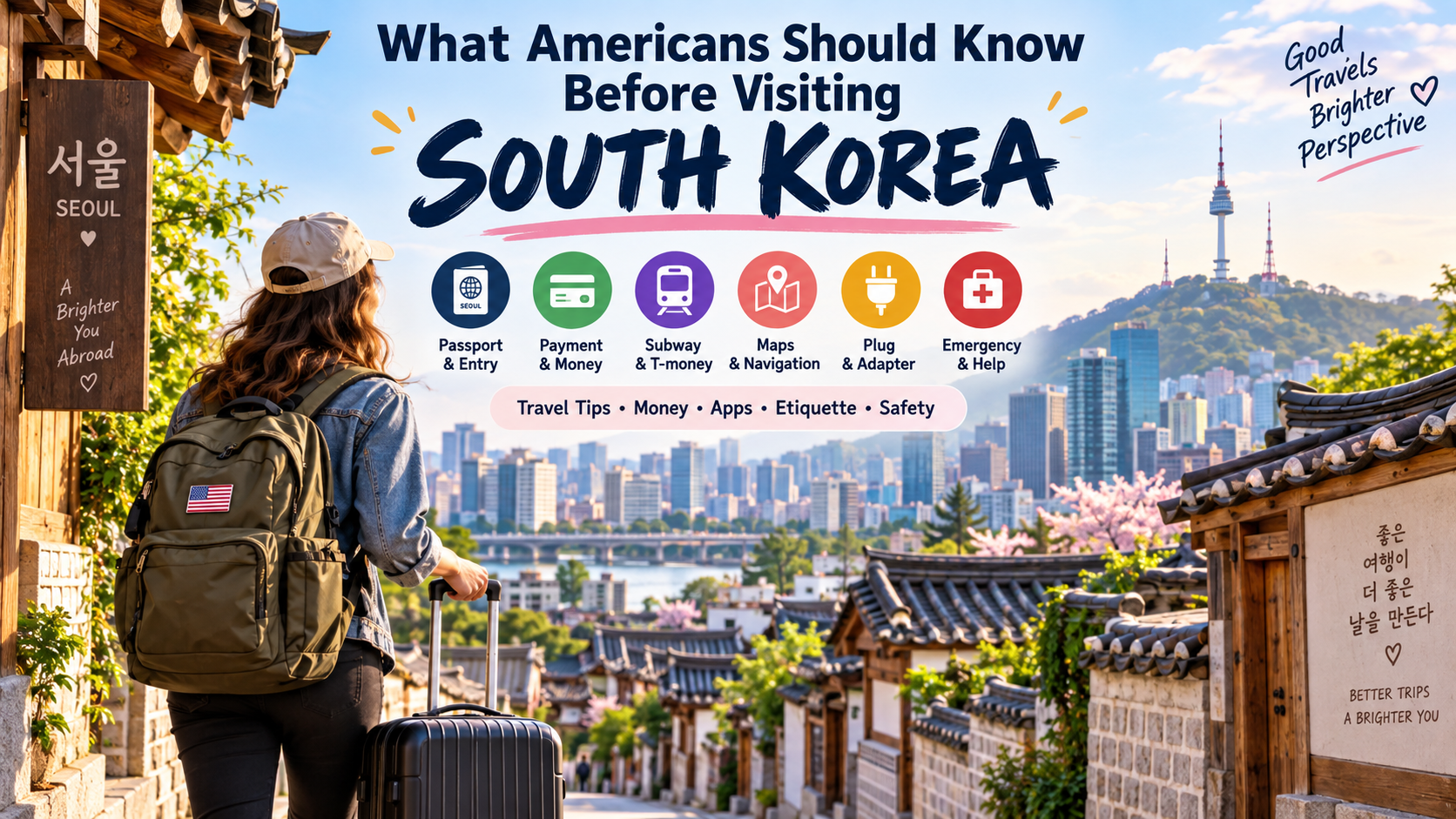
South Korea is one of the easiest countries in Asia for American travelers to visit independently.
Public transportation is excellent.
Credit cards are widely accepted.
Major tourist attractions usually have English signage.
Cities are generally easy to navigate once you understand a few local systems.
But Korea also works differently from the United States in several small ways.
Google Maps may not behave the way you expect.
Tipping isn’t normal.
Your U.S. electrical plug won’t fit every outlet.
Restaurants may use self-service ordering.
And transportation cards are much more important than many first-time visitors realize.
If you’re traveling from the United States to South Korea for the first time, here are the things worth knowing before you get on the plane.
Quick Checklist Before Flying to Korea
Before leaving the United States, make sure you have:
- Valid passport
- Entry requirements checked
- Hotel address saved
- eSIM or mobile data plan
- Naver Map installed
- Papago installed
- Credit card with no foreign transaction fee
- Some backup cash
- Travel adapter
- Comfortable walking shoes
That covers most of the practical problems first-time visitors encounter.
1. Check Korea’s Entry Requirements Before You Fly
This should always be your first step.
As of 2026, U.S. citizens are included in South Korea’s temporary K-ETA exemption, which has been extended through December 31, 2026.
The Embassy of the Republic of Korea in the United States specifically confirms that the current exemption includes U.S. travelers.
That means eligible American travelers covered by the exemption do not need to obtain K-ETA solely because of the normal visa-waiver travel authorization requirement during the exemption period.
However, entry rules can change.
Always confirm the current rules close to your departure date.
What Is K-ETA?
K-ETA stands for:
Korea Electronic Travel Authorization
It is Korea’s electronic travel authorization system for eligible visa-free travelers.
Even during the temporary exemption period, travelers who qualify for exemption may still voluntarily apply for K-ETA.
The official K-ETA notice says approved K-ETA holders receive benefits such as not having to complete a separate arrival card.
The official application fee is currently ₩10,000, and normal processing may take up to 72 hours.
Important: Don’t Use Random K-ETA Websites
There are third-party websites that look official and charge additional fees.
If you need K-ETA, use the official Korean government K-ETA website.
This matters because travel-authority scams and unnecessary service charges are common around the world.
2. Korea Uses the Won, Not Dollars
South Korea’s currency is the:
Korean won
symbol:
₩
Common banknotes include:
- ₩1,000
- ₩5,000
- ₩10,000
- ₩50,000
The Korea Tourism Organization confirms the won as Korea’s official monetary unit.
How Much Is ₩10,000?
Exchange rates change constantly, so don’t memorize an exact dollar conversion.
Instead, use a currency converter.
After a day or two, you’ll start getting used to thinking directly in won.
That’s easier than converting every coffee purchase into dollars.
3. Credit Cards Are Widely Accepted
This is good news for American travelers.
Credit cards are widely used throughout Korea.
VISITKOREA notes that major hotels, department stores and ordinary shops commonly accept cards including:
- Visa
- Mastercard
- American Express
although acceptance can vary by individual business.
For most travelers, you do not need to carry a huge amount of cash.
But You Should Still Carry Some Korean Won
Keep some cash for:
- T-money recharging
- Traditional markets
- Small shops
- Older vending machines
- Backup payment
A reasonable approach is:
credit card as your main payment method
plus
cash as backup
4. Don’t Expect American Tipping Culture
This is one of the biggest differences.
In ordinary Korean:
- Restaurants
- Cafés
- Taxis
- Bars
you generally do not need to add the 18–25% tip Americans are used to.
You pay the listed price.
That’s it.
You also don’t normally leave cash on a restaurant table after eating.
For Americans, this can initially feel strange.
Enjoy it.
5. Get a T-Money Card
For public transportation, buy a T-money card.
It can be used on:
- Seoul subway
- Buses
- Many taxis
- Airport-related transportation
- Some convenience-store purchases
Seoul’s 2026 official guide describes T-money as a rechargeable transportation card usable across buses, subways, taxis and participating convenience stores.
How to Use T-Money
For the subway:
Tap when entering
and
tap when leaving
For buses:
Tap when boarding
and
tap again when getting off
That second tap is important for transfer discounts.
Seoul’s integrated transportation system requires proper tapping when boarding and exiting to calculate transfer fares correctly.
6. Seoul Subway Fares Are Cheap
As of the current Seoul fare schedule, the adult base subway fare is:
₩1,550 with a transportation card
and
₩1,650 with a single-use ticket.
Compared with transportation costs in many major U.S. cities, public transportation in Seoul is inexpensive.
That’s one reason I recommend using the subway rather than relying on taxis.
7. Download Naver Map Before Arriving
This may be the single most useful practical tip in this guide.
American tourists naturally open:
Google Maps
But Korea’s local mapping environment is different.
For detailed local navigation, download:
Naver Map
or
KakaoMap
before your trip.
Use these apps for:
- Subway directions
- Walking routes
- Bus routes
- Restaurants
- Exit numbers
- Local addresses
Google Maps can still be useful as a secondary reference, but I would not make it your only navigation app.
8. Download Papago
Papago is a Korean-focused translation app.
It’s useful for:
- Menus
- Signs
- Messages
- Conversations
- Korean websites
You can point your phone camera at Korean text and translate it.
You absolutely can travel through Korea without speaking Korean.
A translation app simply makes the experience smoother.
9. Learn Two Korean Phrases
You do not need to learn Korean before your trip.
But learn these:
Annyeonghaseyo
Hello.
Gamsahamnida
Thank you.
Even a small effort is generally appreciated.
Pronunciation does not need to be perfect.
10. English Is Useful, but Don’t Expect It Everywhere
In major tourist areas such as:
- Myeongdong
- Hongdae
- Gangnam
- Itaewon
- Airports
- Major hotels
you will often find English signage and some English-speaking staff.
But outside tourist areas, English ability varies widely.
Don’t assume every taxi driver, restaurant owner or shop worker will speak English.
Use:
Naver Map + Papago
and you will be fine.
11. Korea Uses Different Electrical Outlets Than the U.S.
American travelers need to pay attention to plugs.
South Korea generally uses 220V electricity and European-style round-pin plugs.
Typical sockets are compatible with:
Type C
and
Type F
plugs.
Most modern phone and laptop chargers support:
100–240V
so you usually only need a plug adapter.
But check the label on your device.
If it says only:
120V
you may need a voltage converter.
Hair dryers and styling tools deserve particular attention.
12. Get an eSIM or SIM Card
Mobile data makes travel in Korea dramatically easier.
You’ll use it constantly for:
- Naver Map
- Subway routes
- Papago
- Restaurant searches
- Messaging
- Taxi apps
For most Americans, an eSIM is the easiest option if your phone supports it.
You can activate it before or after arrival depending on the provider.
Physical SIM cards and portable Wi-Fi devices are also widely available.
13. Korea Has Excellent Convenience Stores
Do not underestimate them.
Major chains include:
- CU
- GS25
- 7-Eleven
- emart24
You can buy:
- Drinks
- Food
- Snacks
- Coffee
- Toiletries
- Transportation cards
- Basic travel supplies
Many stores also sell surprisingly decent ready-made meals.
Visiting a Korean convenience store becomes part of the travel experience for many visitors.
14. Restaurants Work Differently From the U.S.
Several small differences may surprise you.
Some restaurants have:
Table buttons
Press the button when you need staff.
Others use:
- Tablets
- QR menus
- Self-ordering kiosks
Some provide:
- Self-service water
- Self-service side dishes
- Self-service utensils
Don’t sit for 15 minutes waiting for a server to repeatedly check on you.
The service model can be different.
15. You Usually Pay at the Counter
At many Korean restaurants, you don’t give your credit card to a server at the table.
Instead:
finish eating → walk to the counter → pay
This varies by restaurant, but it is extremely common.
If you’re unsure, watch what other customers do.
16. Korean BBQ May Require Two Orders
Solo travelers should know this.
Some Korean BBQ restaurants require a minimum of:
two servings of meat
even if only one person is dining.
This is not necessarily an attempt to overcharge tourists.
Korean BBQ is traditionally a shared meal.
If traveling alone, search for:
solo Korean BBQ
or restaurants specifically accommodating one-person dining.
17. Korea Involves a Lot of Walking
Even if you use the subway everywhere, you may walk far more than expected.
Why?
Because:
- Subway stations are huge
- Transfers can involve long corridors
- Seoul has hills
- Tourist districts are best explored on foot
A normal sightseeing day can easily involve:
15,000–25,000 steps
Comfortable shoes matter more than fashionable shoes.
Your feet will submit their review of this advice by Day 2.
18. Subway Exit Numbers Matter
This sounds minor.
It isn’t.
Large Seoul stations can have many exits.
For example, getting out at:
Exit 2
instead of
Exit 10
might put you several blocks away or on the wrong side of a huge road.
Navigation apps will usually show the best exit.
Check before you leave the station.
19. Seoul’s Subway Does Not Run 24 Hours
Don’t assume the subway will take you home at 2:00 AM.
Service generally ends around midnight, depending on the line and station.
If you’re out late in:
- Hongdae
- Itaewon
- Gangnam
check your last train beforehand.
After that, you’ll need a taxi or late-night transportation.
20. Use Official Taxis
Korean taxis are generally straightforward to use.
For easier booking, install:
Kakao T
At Incheon Airport, use official taxi stands.
Avoid unauthorized drivers approaching passengers inside transportation terminals.
21. Korea Is Generally Very Convenient for Tourists
Tourist infrastructure is strong.
The Korea Tourism Organization operates the 1330 Korea Travel Helpline, which provides travel information, interpretation support and tourist complaint assistance.
If you’re confused about transportation, interpretation or tourism services, remember:
1330
It’s a useful number.
22. Know Korea’s Emergency Numbers
Save these before your trip.
Police
112
Fire and Ambulance
119
VISITKOREA confirms 112 for police and 119 for fire/emergency response.
If you don’t speak Korean, the official guidance says you can request an English interpreter when connected.
23. Don’t Confuse 119 With the U.S. 911 Number
American instinct says:
911
Korean emergency numbers are different.
Remember:
112 = Police
119 = Fire/Ambulance
An easy memory trick:
Korea’s emergency system uses two three-digit numbers that both start with 11.
24. Public Trash Cans Can Be Hard to Find
This surprises many visitors.
Seoul’s streets are often very clean, but public garbage cans can be surprisingly difficult to find.
You may need to carry your trash for a while.
Convenience stores sometimes have waste bins for products purchased there.
Don’t simply leave trash somewhere because you can’t find a bin.
25. Public Bathrooms Are Easier to Find Than Trash Cans
The good news:
Restrooms are widely available in places such as:
- Subway stations
- Shopping malls
- Department stores
- Tourist attractions
Many are clean and free.
So Korea somehow manages the remarkable combination of:
easy toilets + mysterious trash cans.
26. Take Your Shoes Off When Appropriate
Shoes are normally removed inside Korean homes.
You may also encounter shoe-removal rules at:
- Traditional accommodation
- Some restaurants
- Temples
- Certain indoor spaces
If you see several pairs of shoes lined up at the entrance, that’s a strong clue.
Don’t march inside in sneakers like you’re storming a castle.
27. Keep Your Voice Down on Public Transportation
Subways and buses can be crowded, but they are often quieter than American visitors expect.
Try to avoid:
- Speakerphone conversations
- Loud video playback
- Very loud group conversations
Headphones are your friend.
28. Respect Priority Seating
Subway cars have seats designated for:
- Older passengers
- Pregnant passengers
- People with disabilities
- Others needing assistance
Pay attention to the signs.
When in doubt, use ordinary seating.
29. Don’t Expect Huge Personal Space on Rush-Hour Trains
Seoul rush hour is serious.
If you’re traveling around:
7:30–9:00 AM
or
5:30–7:30 PM
popular lines can become extremely crowded.
Avoid moving large luggage during these times if possible.
30. Korea’s Seasons Are Very Different
Do not pack for “Asia.”
Pack for Korea in your specific month.
Korea has four distinct seasons.
Spring
Comfortable but variable.
Summer
Hot, humid and rainy.
Fall
Often one of the most comfortable seasons.
Winter
Cold.
Sometimes very cold.
Check Seoul’s weather shortly before departure.
31. Bring Sun Protection in Summer
Korean summer sun and humidity can be intense.
Bring:
- Sunscreen
- Hat
- Lightweight clothing
- Water
You’ll be walking outside more than you think.
Convenience stores are useful for cold drinks and emergency air conditioning.
32. Korea Is Not Just Seoul
Seoul deserves several days.
But if you have enough time, consider:
Busan
for beaches and coastal culture.
Gyeongju
for ancient Korean history.
Jeju
for nature.
Trying to squeeze all four into seven days, however, is usually too much.
For a first week:
Seoul + Gyeongju + Busan
is a much more sensible route.
33. Don’t Overplan Your Seoul Itinerary
This is one of my strongest recommendations.
A bad Seoul itinerary looks like:
Gyeongbokgung → Gangnam → Hongdae → Seongsu → N Seoul Tower
all in one day.
Technically possible?
Yes.
Enjoyable?
Probably not.
Group neighborhoods geographically.
You’ll experience more by traveling less.
34. Keep Your Passport Accessible
Your passport is your primary identification while abroad.
Some activities such as:
- Hotel check-in
- Tax-refund procedures
- Certain purchases
- Immigration-related procedures
may require it.
However, use reasonable judgment about carrying original identification versus securely storing it depending on what you’re doing.
Keeping a secure digital copy of important travel documents is also sensible.
35. Tax Refunds May Be Available to Tourists
Foreign visitors may qualify for tax refunds on eligible purchases at participating stores.
You’ll often see:
Tax Free
or
Tax Refund
signs.
Rules, thresholds and refund procedures can vary, so check the store’s current process.
Keep receipts where necessary.
This is particularly useful for:
- Cosmetics
- Fashion
- Electronics
- Larger shopping purchases
36. Don’t Assume Every Korean Dish Is Spicy
A common American misconception:
Korean food = extremely spicy food
Not true.
Mild foods include:
- Bulgogi
- Samgyeopsal
- Japchae
- Gimbap
- Mandu
- Samgyetang
- Pajeon
If you don’t like spicy food, you will still eat very well.
37. But When Koreans Say Something Is Spicy, Believe Them
Tteokbokki.
Buldak.
Some stews.
Some noodles.
These can be genuinely hot.
Spice levels vary dramatically.
A polite-looking bowl of red sauce may be preparing an ambush.
Proceed accordingly.
38. Don’t Rely on Only One Payment Method
Take:
one primary credit card
plus
a backup card
plus
some cash
Don’t keep everything together.
If one wallet disappears, you don’t want your entire financial system disappearing with it.
This is basic international-travel risk management, not a Korea-specific concern.
39. Notify Your Bank if Necessary
Many American banks no longer require a travel notification.
Some still have fraud-detection systems that may react to unusual overseas transactions.
Before leaving:
- Confirm overseas use is enabled
- Check foreign transaction fees
- Save the bank’s international support number
A card with no foreign transaction fee is ideal.
40. Korea’s Convenience Can Spoil You
After a few days you’ll get used to:
- Cheap subway rides
- Fast cafés
- Late-night convenience stores
- Delivery culture
- Clean public transportation
- Dense restaurant districts
Then you’ll go home.
Good luck explaining to your neighborhood why you now expect a convenience store every 100 yards.
Best Apps for Americans Visiting Korea
Install these:
| App | Use |
|---|---|
| Naver Map | Navigation |
| KakaoMap | Navigation |
| Papago | Translation |
| Kakao T | Taxis |
| Airline app | Flights |
| eSIM provider app | Mobile data |
| Currency converter | Exchange rates |
You don’t need 20 Korea apps.
These cover most situations.
What Should Americans Pack for Korea?
A practical packing list:
- Passport
- Credit cards
- Some Korean won
- Plug adapter
- Portable battery
- Comfortable walking shoes
- eSIM-compatible phone
- Weather-appropriate clothing
- Small backpack
- Prescription medications
- Copies of travel documents
Avoid overpacking.
Seoul has stores.
Many, many stores.
Most Important Cultural Difference: Observe First
You don’t need to memorize an etiquette textbook.
The easiest approach is:
watch what people around you are doing.
If everyone:
- Removes shoes
- Lines up
- Returns trays
- Pays at the counter
- Uses self-service water
do the same.
Travel becomes much easier when you treat unfamiliar systems as something to observe rather than something that is “wrong.”
Frequently Asked Questions
Do Americans need K-ETA to visit South Korea in 2026?
Eligible U.S. travelers are included in Korea’s current temporary K-ETA exemption through December 31, 2026, according to the Korean Embassy in the United States.
Because immigration rules can change, confirm the requirement again before your departure.
Can Americans use credit cards in Korea?
Yes.
Major credit cards are widely accepted at hotels, shops and many other businesses, though some smaller merchants may differ.
Carry some cash as backup.
Do Americans tip in Korea?
Normally, no.
Tipping is not expected in the same way it is in the United States.
Is Seoul easy for Americans to navigate?
Yes, especially if you install Naver Map or KakaoMap and use a T-money transportation card.
What emergency number should Americans call in Korea?
112 for police.
119 for fire or ambulance.
For tourism assistance and interpretation, use 1330.
Do I need cash in Korea?
You don’t need large amounts, but some cash is useful for transportation-card recharging, traditional markets and backup payments.
Will my U.S. phone work in Korea?
Usually, yes, if the phone is unlocked and compatible with international roaming or a Korean eSIM/SIM.
Check your carrier before traveling.
Can I drink tap water in Korea?
Tap water in Korea is treated to drinking-water standards, but many locals still prefer filtered or bottled water for taste.
Hotels often provide bottled or filtered water.
Final Thoughts
Traveling to South Korea from the United States isn’t difficult.
The biggest adjustment isn’t language.
It’s learning a few different systems.
Use a transportation card.
Use Naver Map instead of relying entirely on Google Maps.
Don’t tip like you’re back in the United States.
Keep some cash.
Bring the correct electrical adapter.
Learn the subway exit number.
Save 112, 119 and 1330.
And don’t schedule every hour of every day.
Once those basics are handled, Korea is an unusually easy country to explore independently.
The best preparation isn’t memorizing every Korean custom before you land.
It’s knowing enough to solve the small practical problems quickly—so you can spend the rest of your trip actually enjoying Korea.