7-Day South Korea Itinerary for First-Time Visitors
Seven days is enough to get a real taste of South Korea without turning your vacation into a race.
For a first trip, the best balance is:
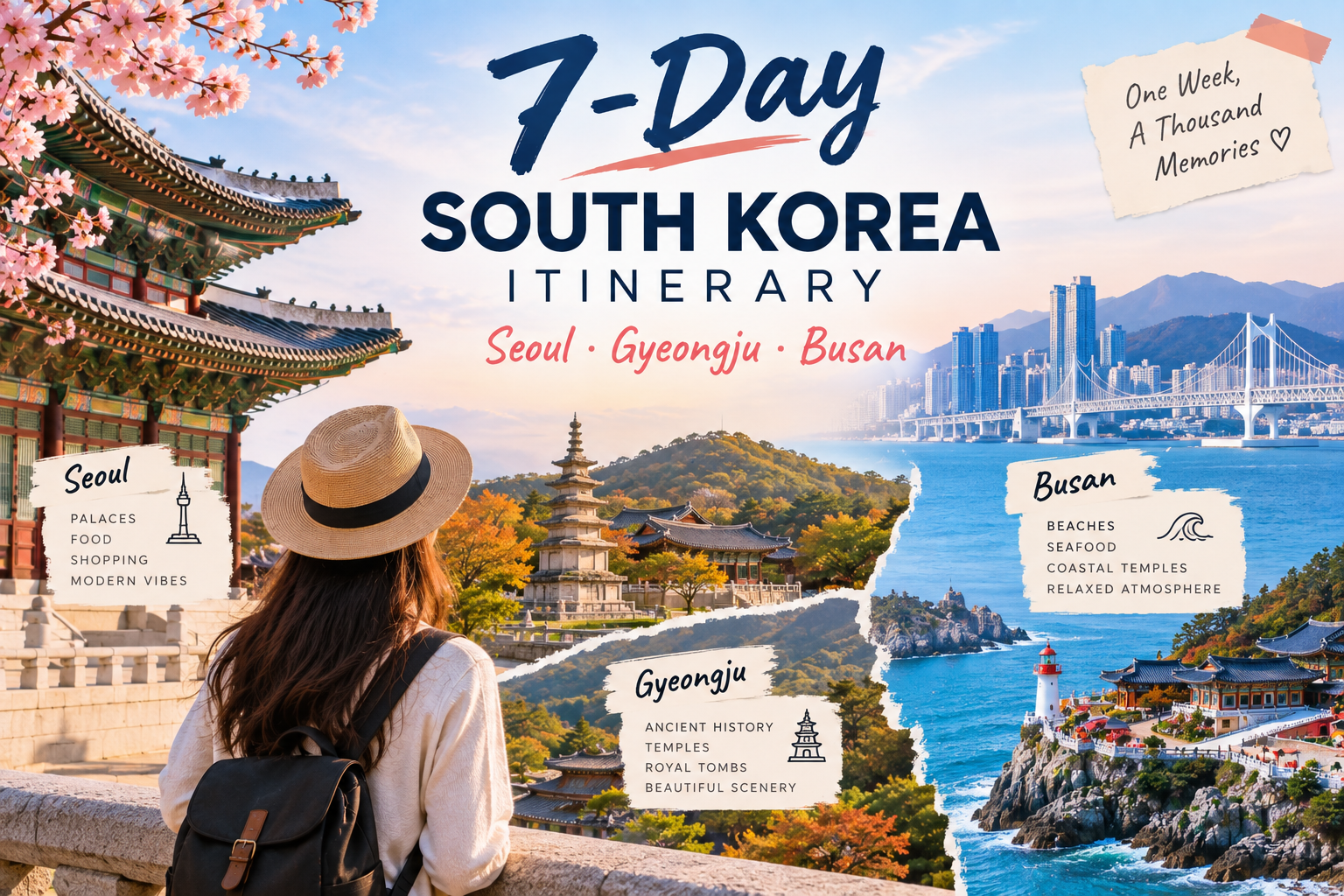
Seoul → Gyeongju → Busan
Why this route?
Seoul gives you modern Korea, royal history, food, shopping, nightlife, K-beauty, and K-pop culture.
Gyeongju introduces you to Korea’s ancient Silla heritage.
Busan gives you beaches, seafood, temples, markets, and a completely different atmosphere from Seoul.
Together, these three cities give first-time visitors a much better understanding of South Korea than spending the entire week in one city.
7-Day South Korea Itinerary at a Glance
| Day | City | Main Highlights |
|---|---|---|
| Day 1 | Seoul | Myeongdong, Namsan, N Seoul Tower |
| Day 2 | Seoul | Gyeongbokgung, Bukchon, Insadong, Gwangjang |
| Day 3 | Seoul | Seongsu, Gangnam, COEX, Han River |
| Day 4 | Gyeongju | Daereungwon, Hwangnidan-gil, Donggung Palace |
| Day 5 | Gyeongju → Busan | Bulguksa, transfer to Busan, Gwangalli |
| Day 6 | Busan | Gamcheon, Jagalchi, Nampo, Songdo |
| Day 7 | Busan | Haeundae, Haedong Yonggungsa, departure |
This route works particularly well because you travel in one direction instead of repeatedly returning to Seoul.
Day 1: Arrive in Seoul
Your first day should be easy.
After a long international flight, don’t build an exhausting schedule.
Incheon Airport to Seoul
You have three main options:
- AREX airport train
- Airport limousine bus
- Taxi
If you’re staying near Seoul Station or Hongdae, AREX is especially convenient.
If you have large luggage and your hotel is near an airport limousine stop, the bus may be more comfortable.
Afternoon: Myeongdong
After checking into your hotel, explore Myeongdong.
For a first-time visitor, Myeongdong is an easy place to start because it combines:
- Korean skincare
- Cosmetics
- Fashion
- Restaurants
- Street snacks
- Department stores
- Convenience stores
The Seoul tourism authority identifies Myeongdong as one of central Seoul’s major shopping areas, with department stores, duty-free shops, global brands and street food. Visit Seoul
If you’re interested in K-beauty, spend some time browsing Olive Young and other cosmetics stores.
Evening: N Seoul Tower
Head toward Namsan in the late afternoon.
Visit N Seoul Tower around sunset.
You’ll get one of the classic views of the Seoul skyline.
The official Seoul first-time itinerary also groups Namsan and N Seoul Tower among the city’s essential first-visit attractions. Visit Seoul
Day 1 Route
Incheon Airport → Hotel → Myeongdong → N Seoul Tower
Day 2: Historic Seoul
Today is about Korea’s royal and traditional heritage.
Morning: Gyeongbokgung Palace
Start your day at Gyeongbokgung Palace.
This was the main royal palace of the Joseon Dynasty and remains one of the most important historic sites in Seoul.
Allow about two hours.
If you’d like, rent a traditional hanbok from one of the nearby rental stores.
Late Morning: Bukchon Hanok Village
Continue to Bukchon Hanok Village.
Bukchon is known for its traditional Korean houses, called hanok.
Remember that this is still a residential neighborhood, so keep noise levels low and follow local visitor restrictions.
Lunch: Insadong
Walk toward Insadong.
This is a good place to eat a traditional Korean lunch.
Try:
- Bibimbap
- Bulgogi
- Korean set meals
- Mandu
- Traditional tea
After lunch, browse craft stores and souvenir shops.
Afternoon: Ikseon-dong
Walk to Ikseon-dong.
This neighborhood mixes old hanok buildings with:
- Cafés
- Dessert shops
- Restaurants
- Boutiques
It’s an easy place to stop for coffee.
Evening: Gwangjang Market
Finish the day at Gwangjang Market.
Seoul’s official tourism guide highlights the market for foods such as bindaetteok and gimbap. Visit Seoul
Try:
- Bindaetteok
- Gimbap
- Mandu
- Kalguksu
- Tteokbokki
- Yukhoe
Day 2 Route
Gyeongbokgung → Bukchon → Insadong → Ikseon-dong → Gwangjang Market
Day 3: Modern Seoul
Day 3 shows you why Seoul has become globally influential in fashion, beauty, food, cafés, and pop culture.
Morning: Seoul Forest
Start at Seoul Forest.
Walk through the park before heading into nearby Seongsu.
Late Morning: Seongsu-dong
Spend a few hours in Seongsu.
You’ll find:
- Korean fashion brands
- K-beauty stores
- Pop-up shops
- Specialty cafés
- Bakeries
- Design stores
Seongsu is especially worth visiting if you want something more contemporary than traditional tourist areas.
Afternoon: COEX
Take the subway south to COEX.
Visit:
- Starfield Library
- COEX Mall
- Bongeunsa Temple
Then continue toward Gangnam.
The official Seoul itinerary also includes Gangnam and Starfield COEX among major first-time attractions. Visit Seoul
Evening: Han River
Finish your final Seoul evening beside the Han River.
Buy fried chicken or convenience-store ramen and enjoy the city lights.
Day 3 Route
Seoul Forest → Seongsu → COEX → Gangnam → Han River
Day 4: Seoul to Gyeongju
It’s time to leave Seoul.
Gyeongju is one of the best places in Korea for travelers interested in history.
It was the capital of the ancient Silla Kingdom, which ruled much of the Korean Peninsula for centuries.
Morning: Travel to Gyeongju
The easiest long-distance option for many visitors is the high-speed train toward Singyeongju Station.
Book your ticket in advance during:
- Weekends
- Korean holidays
- Peak travel seasons
After arriving, transfer into central Gyeongju.
Explore Daereungwon Tomb Complex
Start with Daereungwon.
The huge grassy burial mounds are among the most recognizable sights in Gyeongju.
The area is easy to explore on foot.
Hwangnidan-gil
Walk to Hwangnidan-gil.
This popular area contains:
- Restaurants
- Hanok cafés
- Souvenir shops
- Korean desserts
- Boutique stores
It is an excellent place for lunch and coffee.
Cheomseongdae
Next, visit Cheomseongdae, an ancient astronomical observatory associated with the Silla period.
The surrounding historic district is pleasant to explore on foot.
Evening: Donggung Palace and Wolji Pond
Save Donggung Palace and Wolji Pond for evening.
The historic buildings reflected in the illuminated pond create one of Gyeongju’s most beautiful night scenes.
Day 4 Route
Seoul → Gyeongju → Daereungwon → Hwangnidan-gil → Cheomseongdae → Donggung & Wolji
Day 5: Bulguksa Temple and Busan
Morning: Bulguksa Temple
Start your day at Bulguksa Temple.
Bulguksa is one of Korea’s most significant Buddhist heritage sites and one of the best reasons to include Gyeongju in a first trip.
Allow at least 1.5 to 2 hours.
If you enjoy Korean history, you could also visit Seokguram Grotto.
Travel from Gyeongju to Busan
After lunch, travel south to Busan.
Busan is South Korea’s major coastal city.
The atmosphere is noticeably different from Seoul.
Expect:
- Beaches
- Mountains
- Seafood
- Harbor views
- Coastal temples
- Large traditional markets
Evening: Gwangalli Beach
After checking into your hotel, head to Gwangalli Beach.
The view of Gwangan Bridge after dark is one of Busan’s signature night scenes.
Have dinner near the beach.
Seafood is an obvious choice, but the area also has plenty of:
- Korean BBQ
- Cafés
- Bars
- Fried chicken
- Western food
Day 5 Route
Bulguksa → Busan → Hotel → Gwangalli Beach
Day 6: Old Busan and Markets
Today is the cultural and food-focused side of Busan.
Morning: Gamcheon Culture Village
Start at Gamcheon Culture Village.
The hillside neighborhood is known for:
- Colorful houses
- Narrow alleys
- Murals
- Small cafés
- Coastal views
Wear comfortable shoes.
Busan has hills.
A lot of them.
Lunch: Jagalchi Market
Continue to Jagalchi Market.
This is one of Korea’s best-known seafood markets.
Even if you don’t eat raw seafood, it’s worth visiting for the atmosphere.
Nampo-dong
Walk through Nampo-dong.
Explore:
- BIFF Square
- Gukje Market
- Local street food
- Shopping streets
Try Busan specialties such as:
- Ssiat hotteok
- Dwaeji gukbap
- Milmyeon
- Fish cakes
Late Afternoon: Songdo
If time allows, visit the Songdo waterfront.
The area offers beautiful coastal views and is less hectic than central Busan.
Day 6 Route
Gamcheon Culture Village → Jagalchi → BIFF Square → Gukje Market → Songdo
Day 7: Haeundae and Coastal Busan
Your final day is about the ocean.
Morning: Haedong Yonggungsa Temple
Start early at Haedong Yonggungsa.
Unlike many Korean temples located in the mountains, this temple sits beside the sea.
That makes it one of the most visually distinctive temples in Korea.
Haeundae
Continue to Haeundae Beach.
Haeundae is Busan’s best-known beach and is surrounded by:
- Hotels
- Restaurants
- Cafés
- Shopping
- Coastal attractions
It’s an easy place to spend your final few hours in Korea.
Optional: Blue Line Park
If time allows, explore Haeundae Blue Line Park.
The coastal route provides some of Busan’s best ocean views.
Be careful with timing if you have a flight or train that evening.
Should You Return to Seoul on Day 7?
This depends entirely on your flight.
If your international flight leaves from Incheon the next morning, returning to Seoul on Day 7 may be smarter.
If your schedule allows, consider:
Day 7 afternoon: Busan → Seoul
then sleep near Seoul or Incheon Airport.
Trying to travel from Busan to Incheon Airport immediately before an international flight adds unnecessary risk.
Where Should You Stay?
Seoul
Best first-time areas:
Myeongdong
Best overall convenience.
Hongdae
Best for nightlife and airport access.
Jongno
Best for historic attractions.
Gyeongju
Stay near:
Hwangnidan-gil / Daereungwon
This allows you to walk to many historic attractions and restaurants.
One night is enough for a fast itinerary.
Two nights is better if you prefer slower travel.
Busan
Choose based on your interests.
Haeundae
Best for:
- Beach
- Modern hotels
- Cafés
- First-time visitors
Gwangalli
Best for:
- Night views
- Restaurants
- Younger atmosphere
Nampo
Best for:
- Markets
- Seafood
- Old Busan
- Lower-cost accommodation
How Much Does a 7-Day Korea Trip Cost?
Your biggest cost will usually be accommodation.
A rough per-person, excluding international airfare and shopping budget might look like this:
| Travel Style | Approximate 7-Day Budget |
|---|---|
| Budget | ₩600,000–₩900,000 |
| Mid-range | ₩1,000,000–₩1,600,000 |
| Comfortable | ₩1,700,000+ |
These numbers can vary substantially depending on hotel quality, train tickets, restaurants and activities.
K-beauty shopping can destroy a budget with remarkable efficiency.
Consider yourself warned.
What to Pack for One Week in Korea
Bring:
- Comfortable walking shoes
- Portable charger
- Travel adapter
- Light day bag
- Reusable water bottle
- Weather-appropriate layers
You will probably walk more than expected.
Especially in Seoul, Gyeongju and Busan.
Essential Apps
Install these before your trip.
Naver Map
Useful for:
- Navigation
- Subway routes
- Bus routes
- Restaurants
- Korean addresses
KakaoMap
Another excellent navigation app.
Papago
Useful for Korean-English translation.
Kakao T
Useful for taxis.
Having these four apps makes independent travel around Korea much easier.
Should You Add Jeju to a 7-Day Trip?
For most first-time visitors, no.
This is one area where more destinations do not automatically make a better itinerary.
Trying to fit:
Seoul + Gyeongju + Busan + Jeju
into seven days usually means too much time spent:
- Checking out
- Traveling
- Waiting
- Checking in
- Packing again
For a seven-day first trip, I would choose:
Seoul + Gyeongju + Busan
and save Jeju for a longer trip.
If you have 10 to 14 days, then adding Jeju makes much more sense.
Can You Skip Gyeongju?
Yes.
If you care more about:
- Shopping
- K-pop
- Nightlife
- Cafés
- Modern Korea
you could do:
4 days Seoul + 3 days Busan
instead.
But if you’re interested in Korean history and culture, Gyeongju adds something neither Seoul nor Busan can fully replace.
Is Seven Days Enough for South Korea?
Seven days is enough for a very good introduction.
It is not enough to “see Korea.”
And that’s fine.
A successful first trip should leave you wanting to come back.
With this itinerary, you’ll experience:
- Royal Seoul
- Modern Seoul
- Korean food
- Traditional markets
- K-beauty and shopping
- Ancient Silla history
- Buddhist temples
- Busan seafood
- Korean beaches
- The Han River
- Korean high-speed rail
That’s a surprisingly complete introduction in one week.
Frequently Asked Questions
What is the best 7-day itinerary for first-time visitors to Korea?
For most first-time travelers:
3 days Seoul + 2 days Gyeongju + 2 days Busan
is a strong balance.
If you prefer modern city travel, spend an extra day in Seoul and reduce Gyeongju to one night.
Should I visit Seoul or Busan first?
If you arrive at Incheon Airport, start in Seoul.
Then travel south:
Seoul → Gyeongju → Busan
This minimizes unnecessary backtracking.
Is Gyeongju worth visiting?
Yes, particularly if you’re interested in Korean history.
Seoul explains Joseon-era Korea well.
Gyeongju introduces you to a much older period of Korean history.
Is Busan worth visiting on a first trip?
Yes.
Busan provides a very different experience from Seoul with beaches, seafood markets, coastal temples and a more relaxed atmosphere.
Should I buy train tickets in advance?
For normal weekdays, you may have flexibility.
For weekends, Korean public holidays and peak travel periods, booking ahead is safer.
Do I need a rental car?
No.
This entire itinerary can be completed using:
- Trains
- Subway
- Buses
- Taxis
A rental car is unnecessary for most first-time visitors following this route.
Final Thoughts
For a first trip to South Korea, don’t try to collect cities.
Try to understand the contrast between them.
Start in Seoul, where ancient palaces sit beside futuristic neighborhoods.
Then travel to Gyeongju and walk through more than a thousand years of Korean history.
Finish in Busan, eating seafood beside the ocean and watching the sun set over the coast.
Seven days goes quickly.
But Seoul + Gyeongju + Busan gives you history, food, modern culture, shopping, temples, markets, mountains and the sea without turning the entire trip into transportation.
For a first week in Korea, that’s hard to beat.