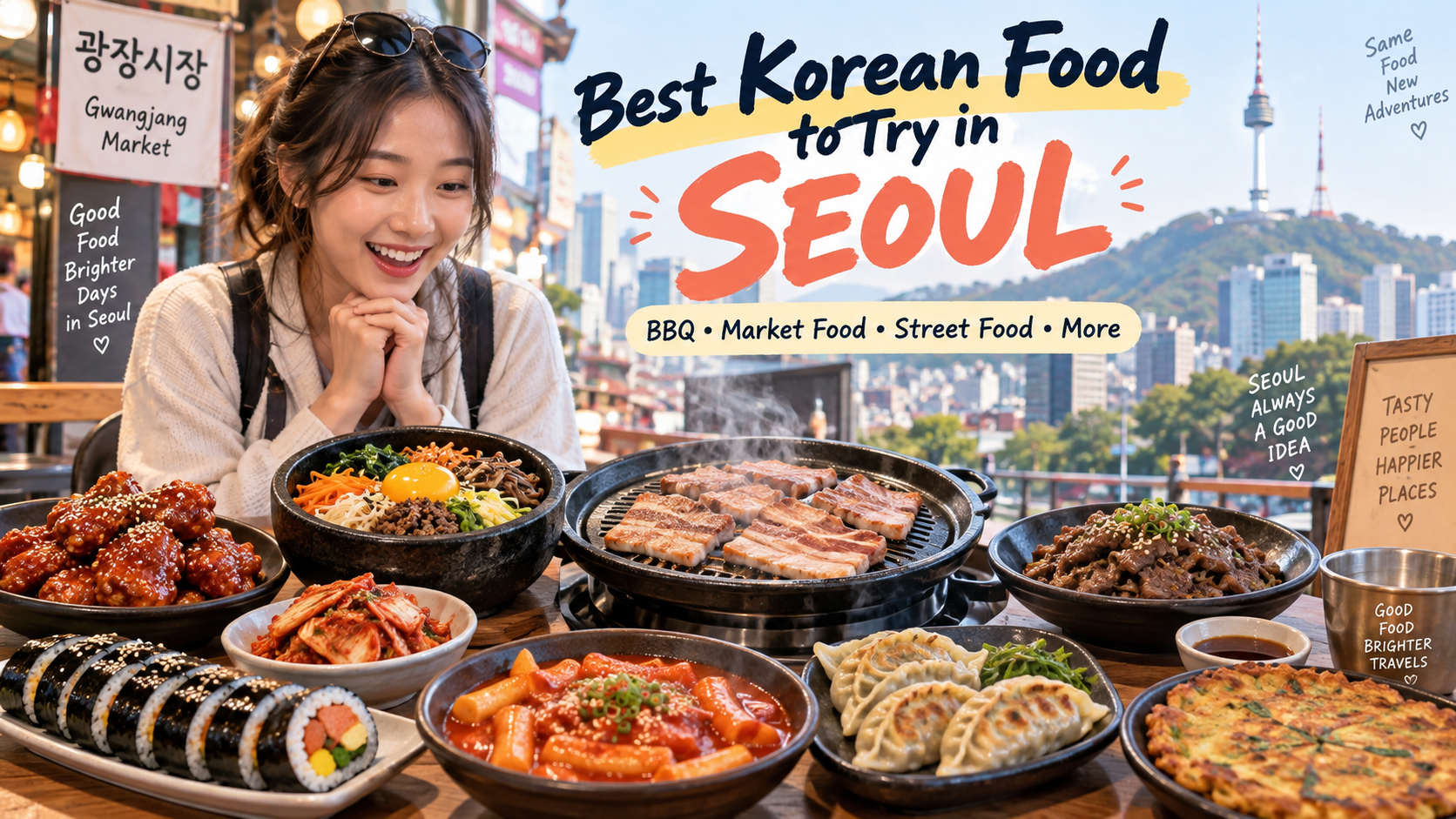
For many first-time visitors, food ends up being one of the best parts of a trip to Seoul.
And Korean food is much bigger than Korean barbecue.
One day you might be grilling pork belly at your table.
The next, eating dumplings in a traditional market.
Then cold buckwheat noodles for lunch, fried chicken beside the Han River at sunset, and convenience-store ramen at midnight.
That variety is what makes eating in Seoul so much fun.
If this is your first visit to South Korea, here are 15 Korean foods you should try in Seoul at least once.
Seoul Food Guide at a Glance
| Food | What It Is | Spice Level | Best For |
|---|---|---|---|
| Samgyeopsal | Grilled pork belly | Mild | Korean BBQ |
| Bulgogi | Sweet-marinated beef | Mild | Beginners |
| Bibimbap | Rice mixed with vegetables | Mild–Medium | Easy first meal |
| Korean Fried Chicken | Crispy fried chicken | Mild–Spicy | Dinner |
| Tteokbokki | Spicy rice cakes | Spicy | Street food |
| Gimbap | Rice rolls | Mild | Quick meal |
| Bindaetteok | Mung bean pancake | Mild | Market food |
| Mandu | Korean dumplings | Mild | Snack/lunch |
| Samgyetang | Ginseng chicken soup | Mild | Traditional meal |
| Naengmyeon | Cold noodles | Mild–Spicy | Summer |
| Gukbap | Soup with rice | Mild | Comfort food |
| Kimchi Jjigae | Kimchi stew | Medium–Spicy | Everyday Korean food |
| Japchae | Glass noodles | Mild | Beginners |
| Yukhoe | Korean beef tartare | Mild | Adventurous eaters |
| Chimaek | Chicken + beer | Varies | Han River evening |
1. Samgyeopsal — Korean Pork Belly BBQ
If you’re visiting Korea for the first time, samgyeopsal should probably be your first Korean barbecue meal.
Samgyeopsal means thick slices of pork belly grilled directly at the table.
You usually eat it with:
- Lettuce
- Garlic
- Ssamjang
- Kimchi
- Green onion salad
- Various banchan side dishes
Take a piece of meat, add a little sauce and garlic, wrap everything in lettuce, and eat it in one bite.
That’s called a ssam.
Why First-Time Visitors Usually Love It
It’s familiar enough to be easy to enjoy but still feels completely Korean because of the tabletop grilling and side dishes.
Spice Level
★☆☆☆☆
The meat itself isn’t spicy.
Best Time
Dinner.
Good Areas to Try It
- Hongdae
- Jongno
- Myeongdong
- Gangnam
- Mapo
2. Bulgogi — Sweet and Savory Korean Beef
If you aren’t comfortable with spicy food, start with bulgogi.
Thin slices of beef are marinated in a sweet-savory mixture typically containing ingredients such as soy sauce, garlic and sesame.
It is usually much milder than people expect Korean food to be.
Why Americans Often Like Bulgogi
The flavor profile is accessible:
savory + slightly sweet + grilled beef
It’s one of the easiest introductions to Korean cuisine.
Spice Level
☆☆☆☆☆
Usually not spicy.
Great For
- Children
- First Korean meal
- Travelers sensitive to spicy food
3. Bibimbap — Korea in One Bowl
Bibimbap literally refers to mixed rice.
A typical bowl contains:
- Rice
- Vegetables
- Egg
- Meat
- Sesame oil
- Gochujang
You mix everything together before eating.
The red gochujang sauce can be spicy, so if you’re sensitive to heat, add only a little.
Dolsot Bibimbap
Try dolsot bibimbap if possible.
It arrives in a very hot stone bowl.
The rice touching the bowl becomes crispy.
That crispy bottom layer may be the best part.
Spice Level
★☆☆☆☆–★★☆☆☆
You control much of the heat yourself.
4. Korean Fried Chicken
Yes, you’ve probably eaten fried chicken before.
Korean fried chicken is different enough to deserve its own meal.
Common styles include:
Fried
Plain crispy chicken.
Yangnyeom
Sweet, spicy, sticky sauce.
Soy Garlic
Savory and slightly sweet.
Many restaurants allow you to order half-and-half, so you can try two flavors.
5. Chimaek — Fried Chicken and Beer
Chimaek combines:
chi from chicken
and
maek from maekju, the Korean word for beer.
But chimaek is more than a menu item.
It’s a social experience.
One of the classic ways to enjoy it is beside the Han River.
Seoul’s official 2026 food guide specifically highlights fried chicken and beer by the Han River as a modern Seoul food tradition.
Try It Like This
Go to:
Yeouido Hangang Park
or
Banpo Hangang Park
around sunset.
Order fried chicken, sit beside the river and watch Seoul light up.
That’s a Seoul experience, not just dinner.
6. Tteokbokki — Spicy Rice Cakes
You will see tteokbokki almost everywhere.
It consists of chewy cylindrical rice cakes cooked in a thick red sauce usually based on gochujang.
The texture is often surprising for first-time visitors.
It’s chewy rather than soft like pasta.
Spice Level
★★★★☆
This one can genuinely be spicy.
Don’t trust someone who tells you:
“Korean spicy isn’t that spicy.”
Sometimes it absolutely is.
Where to Try Tteokbokki
Traditional markets are a good starting point.
Another famous destination is Sindang-dong Tteokbokki Town, which Seoul’s 2026 official K-Food itinerary includes as a dedicated tteokbokki stop.
7. Gimbap — Korea’s Perfect Travel Food
Gimbap consists of rice and fillings rolled in dried seaweed.
Common fillings include:
- Egg
- Carrot
- Pickled radish
- Spinach
- Ham
- Tuna
- Beef
You’ll sometimes hear it described as “Korean sushi.”
That’s convenient shorthand, but it isn’t really accurate.
Gimbap uses different seasoning, fillings and culinary traditions.
It’s one of Korea’s most practical everyday foods.
Mini Gimbap at Gwangjang Market
Gwangjang Market is particularly famous for small mini gimbap rolls.
Seoul’s 2026 official first-timer food guide specifically identifies mini gimbap as one of the city’s representative foods to experience.
Spice Level
☆☆☆☆☆
Excellent for travelers who don’t like spicy food.
8. Bindaetteok — Mung Bean Pancake
If you’re visiting Gwangjang Market, try bindaetteok.
It’s a thick savory pancake made primarily from ground mung beans with vegetables and often meat.
The outside becomes crispy while the inside remains softer.
Gwangjang Market’s official tourism page lists bindaetteok among the market’s signature foods.
Try It With
Traditionally:
makgeolli, Korean rice wine.
Even without alcohol, bindaetteok is worth trying.
9. Mandu — Korean Dumplings
Mandu are Korean dumplings.
They may be:
- Steamed
- Boiled
- Fried
- Served in soup
Fillings commonly include meat, vegetables, tofu and noodles.
They’re inexpensive, familiar and very easy for first-time visitors.
Spice Level
☆☆☆☆☆
Usually mild.
If you’re traveling with someone hesitant about Korean food, start here.
10. Samgyetang — Ginseng Chicken Soup
Samgyetang is one of Korea’s best traditional chicken dishes.
A small whole chicken is stuffed with ingredients such as:
- Glutinous rice
- Garlic
- Jujube
- Ginseng
and simmered in broth.
The result is mild and comforting rather than spicy.
Interestingly, Koreans traditionally eat samgyetang during some of the hottest days of summer.
The custom follows the idea of “fighting heat with heat.”
Seoul’s official 2026 first-time food guide specifically recommends samgyetang as a way to experience this seasonal Korean tradition.
Spice Level
☆☆☆☆☆
11. Naengmyeon — Korean Cold Noodles
Cold noodle soup may sound strange until you’ve spent a humid summer afternoon walking around Seoul.
Then it makes perfect sense.
Naengmyeon is served cold, often extremely cold.
There are two major styles visitors commonly encounter.
Mul Naengmyeon
Noodles in chilled broth.
Bibim Naengmyeon
Noodles mixed with spicy sauce.
The official Seoul food guide notes the distinction between Pyeongyang-style naengmyeon, known for a subtle broth and buckwheat noodles, and Hamheung-style noodles with spicier sauce and chewier noodles.
Spice Level
Mul naengmyeon: ☆☆☆☆☆
Bibim naengmyeon: ★★★☆☆–★★★★☆
12. Gukbap — Soup With Rice
Want to eat something Koreans actually eat as an ordinary meal?
Try gukbap.
“Guk” means soup.
“Bap” means rice.
There are many versions.
You may encounter:
- Beef soup
- Pork soup
- Sundae soup
- Bean sprout soup
It’s filling, inexpensive and particularly satisfying in cold weather.
Traditional Korean restaurants throughout Seoul still serve gukbap as an everyday staple; recent official Seoul restaurant guidance also lists it among representative hearty Korean dishes.
13. Kimchi Jjigae — Kimchi Stew
After a few days in Korea, try kimchi jjigae.
It’s a bubbling stew made with fermented kimchi and usually ingredients such as:
- Pork
- Tofu
- Green onions
It is eaten with rice.
Unlike elaborate tourist meals, kimchi jjigae is everyday Korean comfort food.
Spice Level
★★★☆☆
The flavor isn’t only spicy.
Fermented kimchi creates a deeper sour-savory taste.
14. Japchae — Glass Noodles
Japchae consists of chewy glass noodles stir-fried with:
- Vegetables
- Mushrooms
- Meat
- Soy-based seasoning
- Sesame oil
It is slightly sweet and generally not spicy.
Spice Level
☆☆☆☆☆
This makes japchae another excellent choice for travelers who think:
“I’d love to try Korean food, but I don’t eat spicy food.”
You’ll be fine.
Korean food has plenty of mild dishes.
15. Yukhoe — Korean Beef Tartare
For more adventurous travelers, try yukhoe.
Yukhoe is seasoned raw beef, somewhat comparable in concept to steak tartare.
It’s often served with:
- Sesame oil
- Korean pear
- Egg yolk
Gwangjang Market is particularly famous for yukhoe, and Seoul’s official market guide lists it among the market’s signature dishes.
Obviously, because this is raw meat, choose an established restaurant or reputable vendor.
Spice Level
☆☆☆☆☆
Don’t Ignore Kimchi
Technically, kimchi isn’t one single food.
There are many varieties.
Seoul’s official 2026 guide notes more than 200 recognized varieties, including versions made from cabbage, radish, cucumber, mustard leaves and other vegetables.
You will probably receive kimchi automatically with many meals.
Don’t think of it merely as a side dish.
Fermentation is central to Korean food culture.
Try different types during your trip.
You may find that the kimchi served at one restaurant tastes completely different from the next.
Best Korean Foods for People Who Don’t Like Spicy Food
This is one of the most common misconceptions about Korean cuisine.
Not all Korean food is spicy.
Start with:
Bulgogi
Sweet-savory beef.
Samgyeopsal
Grilled pork.
Japchae
Glass noodles.
Gimbap
Rice rolls.
Mandu
Dumplings.
Samgyetang
Chicken soup.
Pajeon or Bindaetteok
Savory pancakes.
Mul Naengmyeon
Cold noodle soup.
You could spend several days eating Korean food without touching a seriously spicy dish.
Best Korean Foods for Spicy-Food Lovers
If heat is part of the fun, try:
- Tteokbokki
- Dakgalbi
- Kimchi jjigae
- Buldak
- Jeyuk bokkeum
- Bibim naengmyeon
- Spicy seafood stew
Just remember:
Korean restaurants don’t all use the same heat level.
“Spicy” can range from pleasantly warm to questioning every decision that brought you to this moment.
What to Eat at Gwangjang Market
For first-time visitors, I’d focus on four foods:
1. Bindaetteok
Mung bean pancake.
2. Mini Gimbap
Small rice rolls.
3. Yukhoe
Seasoned raw beef.
4. Mandu
Korean dumplings.
The official Gwangjang Market guide also identifies bindaetteok, assorted jeon, mini gimbap, sundae and yukhoe among its well-known foods.
Don’t buy a full serving at every stall.
Share several items.
You’ll taste more without being full after 20 minutes.
Where Should First-Time Visitors Eat in Seoul?
You don’t need to chase famous restaurants for every meal.
Different neighborhoods are good for different experiences.
| Area | Best For |
|---|---|
| Gwangjang Market | Traditional market food |
| Jongno | BBQ, soups, old restaurants |
| Myeongdong | Beginner-friendly variety |
| Hongdae | Chicken, BBQ, late-night dining |
| Seongsu | Cafés and trendy restaurants |
| Euljiro | Older Seoul atmosphere |
| Mangwon | Neighborhood market food |
| Gangnam | Modern dining and BBQ |
| Insadong | Traditional Korean meals |
Korean Restaurant Etiquette for Tourists
Korean restaurants are generally casual, but a few things are useful to know.
Water and Side Dishes May Be Self-Service
If nobody brings water immediately, look for a self-service area.
Banchan Usually Comes With the Meal
Small dishes placed on the table are called banchan.
These may include:
- Kimchi
- Pickled vegetables
- Bean sprouts
- Fish cakes
At many restaurants, basic banchan can be refilled.
Some BBQ Restaurants Require Two Portions
Solo travelers should know this.
Some Korean barbecue restaurants require a minimum order of:
two portions of meat
even for one person.
Search specifically for solo-friendly BBQ restaurants if you’re traveling alone.
Don’t Tip Like You Would in the United States
Tipping is not generally part of ordinary Korean restaurant culture.
Pay the listed amount.
How to Order Food Without Speaking Korean
Don’t panic.
In tourist areas, many restaurants have:
- English menus
- Photos
- Kiosks
- Tablet ordering
- QR menus
Install Papago for translation.
You can also use your phone camera to translate Korean menus.
Useful phrases include:
Annyeonghaseyo
Hello.
Igeo juseyo
This one, please.
An maepge haejuseyo
Please make it not spicy.
Gamsahamnida
Thank you.
You absolutely do not need fluent Korean to eat well in Seoul.
A Perfect One-Day Seoul Food Itinerary
If food is a major reason for your trip, try this.
Breakfast
Korean soup or gimbap.
Lunch
Samgyeopsal or bulgogi.
Afternoon
Korean café and dessert.
Early Evening
Gwangjang Market:
- Mini gimbap
- Bindaetteok
- Mandu
Night
Fried chicken beside the Han River.
That gives you:
home-style food + Korean BBQ + café culture + traditional market + modern Seoul food culture
in one day.
Frequently Asked Questions
What Korean food should a first-time visitor try?
If you only have time for five, choose:
Korean BBQ, bibimbap, gimbap, Korean fried chicken and a traditional soup such as samgyetang.
For a market experience, add bindaetteok or mandu.
Is Korean food very spicy?
Some dishes are.
Many aren’t.
Bulgogi, samgyeopsal, japchae, gimbap, mandu and samgyetang are all good options for people who don’t enjoy spicy food.
What food is Seoul famous for?
Seoul doesn’t have only one defining dish.
Its food culture includes traditional royal and market food, barbecue, naengmyeon, soups, gimbap, fried chicken and contemporary café culture.
Seoul’s own 2026 visitor guide highlights kimchi, samgyetang, naengmyeon, mini gimbap and chimaek as particularly useful introductions to local food culture.
Is Gwangjang Market worth visiting for food?
Yes.
It’s especially useful for first-time visitors because you can try several Korean foods in one place.
Bindaetteok, gimbap and yukhoe are among its most famous dishes.
Can vegetarians eat well in Seoul?
Yes, but it requires more care than some visitors expect.
Even dishes that appear vegetarian may contain:
- Fish sauce
- Anchovy broth
- Meat stock
Look for explicitly vegetarian or vegan restaurants if strict avoidance is important.
What should I eat if I don’t like raw food?
No problem.
Raw dishes such as yukhoe are completely optional.
You have dozens of cooked options including BBQ, fried chicken, soups, dumplings, pancakes, noodles and rice dishes.
Final Thoughts
Don’t spend your first trip to Seoul eating only at places you’ve seen on Instagram.
Try famous food, of course.
But also walk into a busy neighborhood restaurant with a short menu.
Order a bowl of soup.
Eat gimbap from a small shop.
Try food in a traditional market.
Grill pork at your table.
Finish one night with fried chicken beside the Han River.
Korean food makes much more sense when you experience it in the places and situations where Koreans actually eat it.
If you remember only one rule:
Don’t look for one “best Korean food.”
Try different categories.
BBQ.
Soup.
Noodles.
Market food.
Street food.
Banchan.
Fried chicken.
By the end of your trip, you’ll probably have your own answer to what the best Korean food in Seoul really is.
Continue Planning Your Seoul Trip
→ Best Things to Do in Seoul for First-Time Visitors/things-to-do-in-seoul/
→ 5-Day Seoul Itinerary for First-Time Visitors/5-day-seoul-itinerary/
→ Where to Stay in Seoul/where-to-stay-in-seoul/
→ Seoul Subway Guide/seoul-subway-guide/
→ Gwangjang Market Food Guide/gwangjang-market-food-guide/
→ Best Korean BBQ in Seoul/best-korean-bbq-seoul/
→ Best Street Food in Seoul/seoul-street-food/
→ Korean Food for People Who Don’t Like Spicy Food/non-spicy-korean-food/