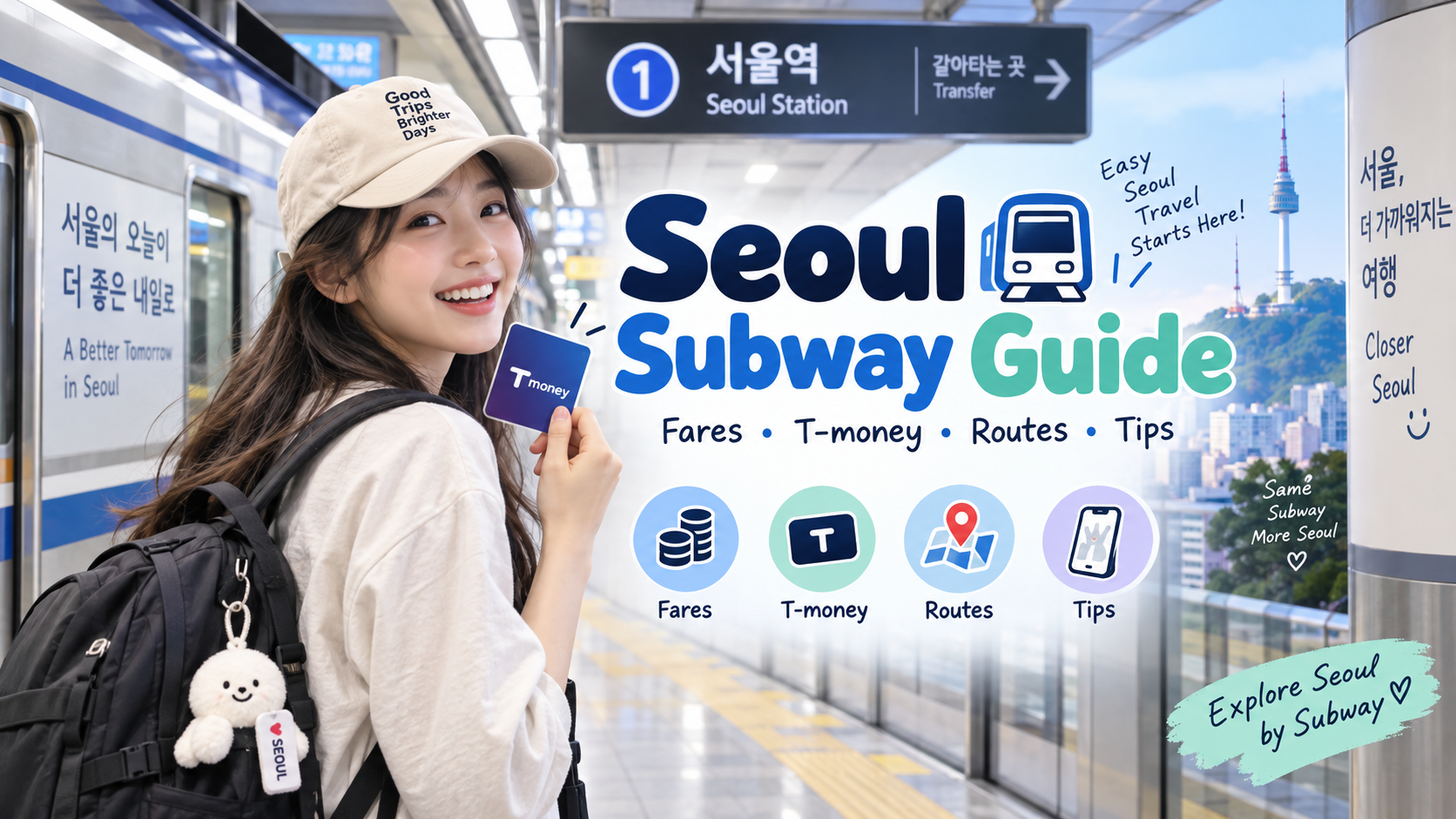
If you’re visiting Seoul for the first time, the subway will probably become your most important form of transportation.
At first glance, the map can look intimidating.
There are dozens of lines, hundreds of stations, different colors, station numbers, and unfamiliar Korean place names.
But here’s the good news:
The Seoul subway is much easier to use than it looks.
Stations are color-coded, major signs include English, exits are numbered, and navigation apps can tell you exactly where to transfer and which exit to use.
Once you’ve taken two or three rides, you’ll probably wonder why you were worried.
This guide explains everything a first-time visitor needs to know.
Seoul Subway at a Glance
For most tourists, remember these five things:
1. Buy a T-money card.
2. Use Naver Map or KakaoMap.
3. Check the line color and station number.
4. Follow signs carefully when transferring.
5. Check your exit number before leaving the station.
That’s about 80% of what you need to know.
How Much Does the Seoul Subway Cost?
As of the current Seoul Metropolitan Government fare schedule, the basic adult subway fare is:
| Ticket Type | Adult Base Fare |
|---|---|
| Transportation card | ₩1,550 |
| Single-use ticket | ₩1,650 |
Children and teenagers have different fares.
The base fare covers the initial distance, and additional charges apply for longer journeys.
For most tourist trips within central Seoul, subway transportation is relatively inexpensive.
Distance-Based Fares
The Seoul subway doesn’t use one completely flat fare for every journey.
For longer distances, the fare increases.
According to Seoul’s official fare structure, additional charges apply after the base-distance allowance.
This means:
Myeongdong → Gyeongbokgung
may cost around the basic fare,
while
central Seoul → distant suburbs
can cost more.
The amount is automatically calculated when you tap out.
You do not need to calculate it yourself.
T-Money Card: The Easiest Option for Tourists
For most visitors, I recommend buying a T-money card.
T-money is a rechargeable transportation card that can be used on Seoul’s:
- Subways
- Buses
- Many taxis
- Some convenience-store purchases
You tap the card when entering the subway and tap again when leaving.
The correct fare is automatically deducted.
Seoul’s official transportation guide recommends rechargeable transportation cards for convenient subway and bus use.
Where Can You Buy a T-Money Card?
You can usually purchase T-money cards at major convenience stores such as:
- CU
- GS25
- 7-Eleven
- Emart24
They are also available at selected transportation facilities and stations.
Look for the T-money logo.
How Do You Add Money to T-Money?
You can recharge your card at:
- Subway station machines
- Convenience stores
- Selected transportation service points
One detail foreign visitors should know:
Payment options can be more limited than Americans may expect.
Don’t assume every machine will accept your overseas credit card.
Keeping some Korean won available for transportation is a good idea.
T-Money vs Single-Use Subway Ticket
You can use Seoul’s subway without T-money.
Every station has machines where you can purchase a single-use transportation card.
But for a multi-day vacation, this becomes annoying.
With a single-use ticket, you have to:
- Find the vending machine
- Choose your destination
- Pay the fare
- Take the ticket
- Use it at the gate
- Return the card afterward for the refundable deposit
Official Seoul tourist information states that single-use subway cards include a ₩500 refundable deposit.
For someone taking the subway several times each day, T-money is much easier.
How to Enter the Subway
When you reach the station:
Step 1
Look for the subway entrance.
You’ll usually see:
- Line number
- Line color
- Station name
Step 2
Go through the ticket gate.
Tap your T-money card on the card reader.
You’ll hear a confirmation sound.
Step 3
Follow the signs for your train direction.
This is where first-time travelers sometimes make mistakes.
Don’t only look at the line number.
Also check the direction.
How Do You Know Which Direction to Take?
Suppose you’re at:
Myeongdong Station
and want to travel to:
Dongdaemun
Both are on Line 4.
You need to choose the platform traveling in the correct direction.
Look at the station names shown on the signs.
Navigation apps make this much easier because they will usually tell you:
- Which line
- Which direction
- How many stops
- Where to transfer
- Which exit to use
Subway Lines Are Color-Coded
Each major Seoul subway line has its own color.
Some important tourist lines include:
Line 1
Useful for:
- Seoul Station
- Jongno
- City Hall
- Dongdaemun
Line 2
One of the most important lines for visitors.
Useful for:
- Hongdae
- City Hall
- Gangnam
- Jamsil
- Seongsu
Line 2 forms a large loop around Seoul.
Line 3
Useful for:
- Gyeongbokgung
- Anguk
- Jongno
- Apgujeong
Line 4
Useful for:
- Myeongdong
- Seoul Station
- Dongdaemun
Line 5
Useful for:
- Gwanghwamun
- Yeouido
- Gimpo Airport
Line 6
Useful for:
- Itaewon
- Gongdeok
- World Cup Stadium
Line 9
Useful for:
- Gangnam-area destinations
- Yeouido
- Gimpo Airport
You do not need to memorize these.
Your phone will do most of the work.
Station Numbers Are Extremely Helpful
Seoul subway stations don’t just have names.
They also have station numbers.
For example, a station may be displayed as:
424 Myeongdong
The number tells you:
- The subway line
- The station’s position on that line
This is extremely useful when Korean station names sound similar.
Instead of remembering only a Korean name, you can confirm the station number.
How to Transfer Between Subway Lines
Transfers are generally straightforward.
Suppose your app says:
Line 2 → Transfer → Line 4
When you arrive at the transfer station, do not leave through the exit gates.
Instead, follow signs marked:
Transfer
or the color and number of the next subway line.
Transfers can involve a fair amount of walking.
Some large stations feel almost like underground neighborhoods.
That is normal.
Some Transfers Are Much Longer Than Others
This deserves emphasis.
On a map, two lines may appear to intersect neatly.
In reality, the transfer can require several minutes of walking through tunnels and escalators.
Large stations such as:
- Seoul Station
- Jongno 3-ga
- Express Bus Terminal
- Gongdeok
- Dongdaemun History & Culture Park
can involve longer transfer walks.
If you’re carrying luggage, avoid unnecessary transfers when possible.
Subway Transfers Don’t Normally Require a New Ticket
If you transfer from one subway line to another inside the station system, you generally do not purchase another ticket.
Follow the transfer signs and continue.
The fare system calculates your journey when you eventually tap out.
Bus and Subway Transfers
One advantage of using a transportation card is Seoul’s integrated public transportation system.
When the rules are satisfied, transfers between buses and subways can receive integrated transfer pricing rather than being treated as entirely separate journeys.
Seoul states that the transfer system requires passengers to correctly tap their transportation card when boarding and getting off applicable transportation.
For tourists:
Tap in. Tap out.
Get into that habit.
The Most Important Seoul Subway Rule: Know Your Exit Number
This is probably the single best tip in this article.
Seoul subway stations can have many exits.
Sometimes:
Exit 1
and
Exit 10
can put you on completely different sides of a huge road or several blocks apart.
So don’t just search for the station.
Search for:
Station + Exit Number
For example:
Myeongdong Station Exit 6
or
Hongik University Station Exit 9
Restaurants, hotels and attractions in Seoul often include the nearest exit number in their directions.
Use it.
Why the Wrong Exit Can Be Annoying
Seoul has:
- Very wide roads
- Large intersections
- Hills
- Underground shopping areas
Choosing the wrong exit can turn a two-minute walk into a 15-minute detour.
Your navigation app will usually recommend the best exit.
Check it before you go upstairs.
Best Subway Apps for Tourists
I would install at least one Korean navigation app before arriving.
Naver Map
My first recommendation.
Useful for:
- Subway routes
- Walking routes
- Bus routes
- Exit numbers
- Restaurants
- Addresses
- Estimated travel time
KakaoMap
Also very useful.
It provides detailed Korean transit information and local navigation.
Subway Korea / Subway Navigation Apps
Dedicated subway apps can also make line transfers visually easier to understand.
Seoul’s official tourism information specifically recommends mobile subway and real-time transit information tools.
What About Google Maps?
American travelers naturally reach for Google Maps.
Google Maps can still help you locate attractions and businesses.
But for detailed public transportation and walking navigation inside Korea, Naver Map and KakaoMap are usually more useful.
My recommendation:
Use:
Naver Map as your primary navigation app
and keep:
Google Maps as a secondary reference.
Seoul Subway Operating Hours
The subway generally operates from approximately:
5:30 AM until around midnight
although exact first and last train times vary by line, station and direction.
This is important.
Do not assume trains operate 24 hours.
Don’t Miss the Last Train
If you’re out drinking in Hongdae, Itaewon or Gangnam, check the last train before midnight.
The last train at your station isn’t necessarily the last train all the way to your destination.
Some trains terminate earlier along the line.
Use a transit app to check the specific route.
If you miss the subway, you may need:
- A night bus
- Taxi
- Kakao T
Is the Subway Safe at Night?
Seoul’s subway is widely used late into the evening.
Normal urban precautions still apply:
- Keep track of your belongings
- Stay aware of your surroundings
- Don’t fall asleep with valuables unsecured
- Check your destination before the last train
For most visitors, public transportation is one of the easiest ways to move around Seoul.
Seoul Subway Etiquette
There are a few cultural habits worth knowing.
Let People Exit First
Stand to the side of the doors.
Let passengers get off before boarding.
Keep Your Voice Down
Subway cars are often relatively quiet.
Loud conversations or speakerphone calls will stand out.
Priority Seats
Certain seats are designated for:
- Older passengers
- Pregnant passengers
- People with disabilities
- Passengers needing assistance
Pay attention to signs.
Don’t Block the Doors
Move farther into the car when it is crowded.
Seoul rush hour can get very busy.
Avoid Rush Hour If You Have Luggage
The busiest periods generally correspond to morning and evening commuting hours.
If you’re carrying two suitcases, entering a packed subway car at commuter time is not fun.
For airport travel with heavy luggage, an airport bus or taxi can sometimes be the better choice.
Is the Seoul Subway Good With Luggage?
Usually, yes.
But there is an important qualification.
Most major stations have elevators or escalators somewhere.
That does not mean the elevator will be conveniently located near your exact entrance, platform or transfer path.
A station that looks simple on the map may involve:
- Long corridors
- Several escalators
- Stairs
- Underground shopping areas
If you have large suitcases, minimize transfers.
Using the Subway From Incheon Airport
The Airport Railroad is called:
AREX
There are two main services:
Express Train
and
All-Stop Train
The All-Stop service connects the airport with useful stations such as:
- Hongik University
- Gongdeok
- Seoul Station
But airport railway sections can have separate or additional fare rules compared with ordinary central-Seoul subway travel. Seoul’s official guidance specifically notes additional charges on certain Airport Railroad sections.
Best Subway Stations for Major Seoul Attractions
| Attraction | Useful Station |
|---|---|
| Gyeongbokgung Palace | Gyeongbokgung |
| Bukchon Hanok Village | Anguk |
| Insadong | Anguk / Jonggak |
| Myeongdong | Myeongdong |
| N Seoul Tower | Myeongdong + onward travel |
| Gwangjang Market | Jongno 5-ga |
| Hongdae | Hongik University |
| Seongsu | Seongsu |
| Gangnam | Gangnam |
| COEX | Samseong |
| Itaewon | Itaewon |
| Jamsil / Lotte World | Jamsil |
| Yeouido | Yeouido |
| Seoul Station | Seoul Station |
Always check the exact entrance for your destination because large attractions may be closer to one exit than another.
How Long Does It Take to Get Around Seoul?
One mistake travelers make is looking at the map and thinking neighborhoods are close.
Seoul is geographically large.
A cross-city journey can easily take:
30–60 minutes
or longer.
When building an itinerary, group nearby attractions.
For example:
Good
Gyeongbokgung → Bukchon → Insadong
Less Efficient
Gyeongbokgung → Gangnam → Hongdae → Seongsu
You can physically do it.
You just shouldn’t.
Can I Use Apple Pay Directly on the Seoul Subway?
Do not assume an overseas iPhone or Apple Pay setup will function as a Seoul transit card.
Seoul’s own public-transportation guidance notes that certain smartphone transit-card functions are available through supported systems such as Samsung Pay, while Apple Pay transit-card use is not generally offered in the same manner.
For an international visitor, a physical transportation card remains the simpler and more reliable choice.
What Is the Climate Card?
Seoul also offers the Climate Card, an unlimited-use public transportation pass within its applicable service area.
For international visitors, short-term passes are available.
Current VISITKOREA information lists:
- 1-day
- 2-day
- 3-day
- 5-day
- 7-day
short-term Climate Card options.
This can be useful if you plan to ride Seoul public transportation many times each day.
However, coverage restrictions matter.
Not every railway or regional route is included.
So don’t buy one solely because it says “unlimited.”
Check whether your planned transportation is actually covered.
T-Money or Climate Card?
For most first-time visitors:
Choose T-Money if:
- You’re taking a normal number of rides
- You’re traveling outside Seoul
- You want simple pay-as-you-go transportation
- You’re also visiting Busan, Gyeongju or other regions
Consider the Climate Card if:
- You’re staying mainly in Seoul
- You’ll ride public transportation frequently
- The covered network matches your itinerary
For a typical five-day first trip, T-money is still the easiest default choice.
Common Mistakes First-Time Visitors Make
Mistake 1: Getting On in the Wrong Direction
Check the next station listed on the platform.
Mistake 2: Taking the Wrong Exit
Always check the exit number before leaving the station.
Mistake 3: Using Only Google Maps
Install Naver Map or KakaoMap.
Mistake 4: Forgetting to Tap Out
Tap your transportation card when leaving.
Mistake 5: Assuming the Subway Runs All Night
It doesn’t.
Check the last train.
Mistake 6: Carrying Huge Luggage During Rush Hour
Avoid it if possible.
Mistake 7: Underestimating Transfer Walking
A “one-transfer” journey can still involve a lot of walking.
A Real Example: Myeongdong to Hongdae
Suppose you’re staying in Myeongdong and want to visit Hongdae.
Open Naver Map.
Enter:
Myeongdong → Hongik University Station
The app will show:
- Which line to take
- Transfer station
- Travel time
- Number of stops
- Recommended exit
You don’t need to memorize the subway map.
Follow the app and confirm the station numbers along the way.
After doing this once or twice, the system becomes very intuitive.
Is the Seoul Subway Difficult for Americans?
No.
The subway map looks complicated because Seoul has a large network.
But the actual process is simple:
Find station → Tap card → Follow line → Transfer if needed → Tap out
Important station signs include English, and individual exits are numbered. Seoul’s official tourism guide specifically notes the multilingual signage and color-coded line system.
For many American visitors, the biggest adjustment isn’t the subway itself.
It’s realizing how much walking can happen inside a subway station.
How Much Money Should You Load Onto T-Money?
Don’t put a huge amount on the card immediately.
For a normal tourist itinerary, start with a modest balance and recharge when necessary.
For example:
₩20,000–₩30,000
is a reasonable starting amount for several days of ordinary local transportation, depending on how often you ride and whether you use the card for other purchases.
You can always add more later.
Frequently Asked Questions
Is the Seoul subway easy for tourists?
Yes.
Lines are color-coded, stations are numbered, major signage includes English, and navigation apps make route planning straightforward.
How much is the Seoul subway?
The current basic adult fare is ₩1,550 using a transportation card and ₩1,650 using a single-use ticket, before distance-based additions.
Do I need a T-money card?
No, but I strongly recommend one for a multi-day trip.
It saves you from buying an individual ticket for every journey.
Can I buy T-money at a convenience store?
Yes. T-money and other transportation products are sold at participating convenience stores and transit locations.
Does the Seoul subway run 24 hours?
No.
Normal operation is roughly from 5:30 AM until midnight, depending on the station and line.
Is there English on the Seoul subway?
Yes.
Station signs include English as well as Korean, and major transit information is designed to be usable by international visitors.
Is Naver Map better than Google Maps in Seoul?
For detailed local public transportation and walking navigation, Naver Map is generally the more useful primary tool.
Google Maps can still be useful as a secondary reference.
Can I take luggage on the subway?
Yes.
But avoid rush hour and minimize transfers when carrying large suitcases.
Final Recommendation
For your first Seoul trip:
Buy a T-money card.
Install:
Naver Map
and preferably:
KakaoMap
Use the subway for most sightseeing.
Check the station number.
Follow the line color.
Confirm the direction.
And most importantly:
check your exit number before leaving the station.
Once you’ve taken your first few rides, Seoul’s subway stops looking complicated and starts becoming one of the easiest parts of traveling around the city.
You don’t need to understand the entire network.
You only need to understand your next ride.